

What sundowning is — and what it isn’t
Sundowning (also called late-day confusion or sundown syndrome) is not a disease and not a separate diagnosis. The Alzheimer’s Association defines it as a state of confusion that occurs in the late afternoon and into the night, common in people with mid-to-late-stage Alzheimer’s and other dementias (Alzheimer’s Association, Sleep Issues and Sundowning).
The National Institute on Aging adds that sundowning is associated with disruption of the body’s internal clock and reduced exposure to natural light, both of which are common in older adults living indoors most of the day (NIA, Tips for Coping with Sundowning).
Common signs of sundowning
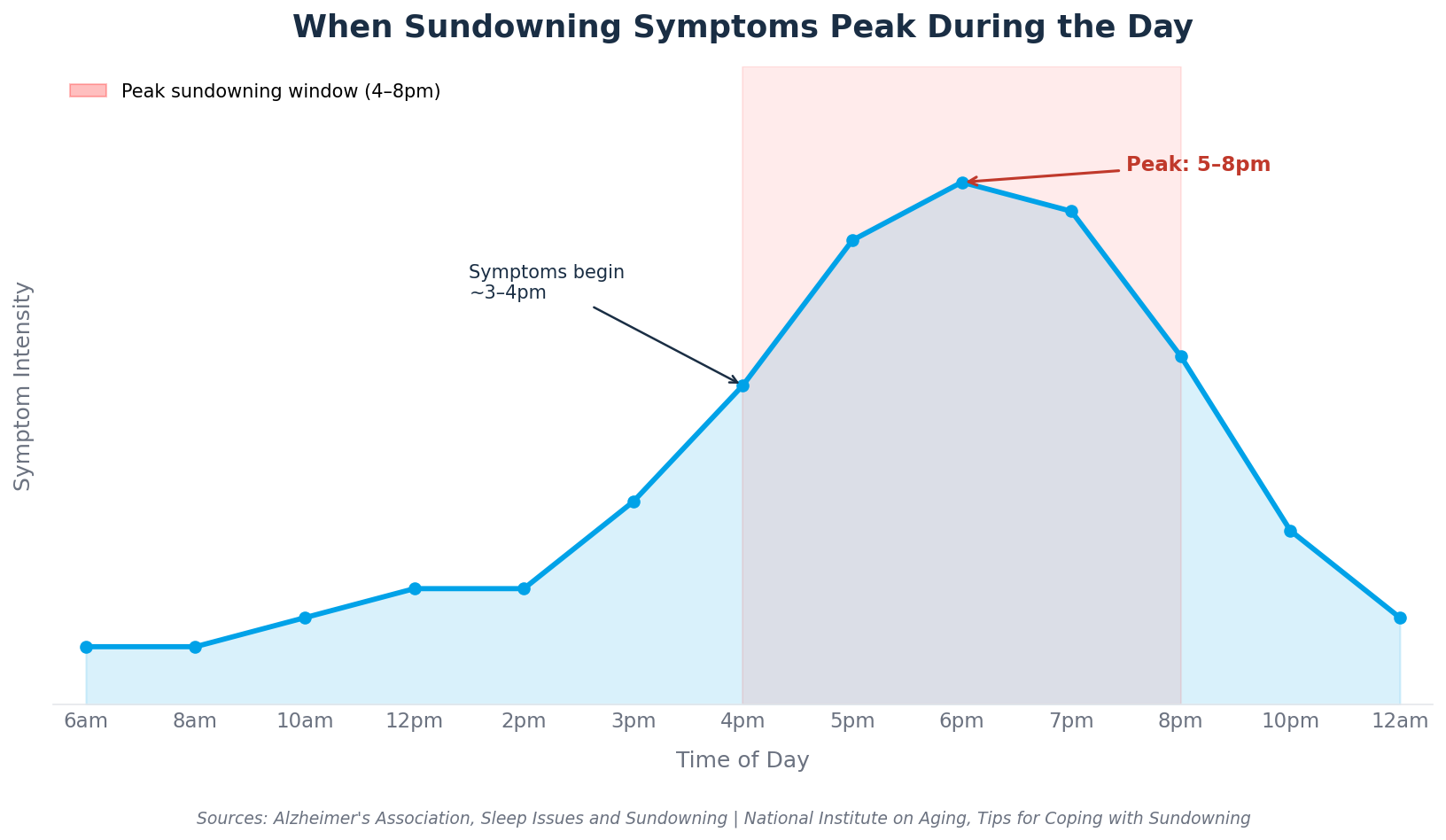
- Increased confusion starting around 3–4pm
- Agitation, pacing, restlessness
- Anxiety or fear, sometimes with crying
- Verbal outbursts, suspiciousness, or accusations
- Wandering, including trying to leave the house
- Hallucinations or delusions (“I have to go pick up the kids,” “Someone is in the house”)
- Difficulty falling asleep or staying asleep
- Reversed sleep-wake cycle in advanced cases
Symptoms often peak between 4pm and 8pm and ease by midnight or after a few hours of rest.
Why sundowning happens
Research summarized by the National Institute on Aging and Alzheimer’s Association points to a multi-factor cause:
Disrupted circadian rhythm
Alzheimer’s damages the suprachiasmatic nucleus — the brain’s master clock. Without proper signals, the body cannot tell day from night.
End-of-day fatigue
The cognitive effort it takes a person with dementia to navigate a normal day is exhausting. By late afternoon, the reserve is gone.
Low ambient light and shadows
Dimming light in the late afternoon creates shadows that the dementia brain cannot interpret. A coat on a chair becomes an intruder.
Hunger, dehydration, or low blood sugar
The gap between lunch and dinner is often too long for an older adult with reduced appetite.
Pain that goes unreported
People with dementia often cannot articulate pain. UTIs, arthritis flares, dental pain, and constipation all cause behavioral escalation.
Overstimulation
Loud TV, multiple visitors, a busy kitchen at dinnertime — all overload the dementia brain.
Medication side effects
Some medications taken in the afternoon cause restlessness or paradoxical agitation.
The 8 evidence-based strategies that actually help
1. Bright morning light
Get the person outside or in front of a sunny window for 30+ minutes within an hour of waking. The NIA notes morning light exposure is one of the most consistently effective non-drug interventions for circadian rhythm in dementia.
2. A predictable daily routine
Same wake time, meal times, walk time, bath time, bed time. Variation costs cognitive energy that is in short supply.
3. Move dinner earlier
Many families see a 50% reduction in sundowning by serving the main meal at 4:30 or 5pm rather than 6:30. A light snack at 7pm bridges to bedtime.
4. Limit caffeine and afternoon naps
No caffeine after noon. If naps are needed, cap at 30 minutes and end before 2pm.
5. Increase light in the home before sunset
Turn on lamps and overhead lights at 3pm, before shadows form. Close curtains to remove the visual cue of darkness outside.
6. Calm the evening environment
Lower the TV volume or turn it off. Limit visitors after 4pm. Play familiar quiet music (the music they listened to in their 20s and 30s).
7. Anticipate physical needs
Offer the bathroom, water, and a snack at 4pm before agitation starts. Many late-day episodes are unmet bathroom needs.
8. Match physical activity to morning hours
Walks, light exercise, and chores in the morning use energy productively. The same activities at 5pm escalate symptoms.
What to do during a sundowning episode
The Alzheimer’s Association recommends the following in-the-moment response:
- Stay calm and lower your voice. Your tone is contagious.
- Don’t argue or correct. If they say “I have to go to work,” do not say “You are retired.” Say “Work is closed today, let’s have a snack first.”
- Redirect, don’t restrain. Offer a familiar object, a snack, or a different room.
- Check basics. Bathroom? Hungry? In pain? Too hot or cold?
- Reassure with touch if welcomed. A hand on the shoulder or holding hands often calms more than words.
- Reduce stimulation. Lower lights only if the person seems to want quiet; otherwise increase light to reduce shadow confusion.
When sundowning needs medical evaluation
Schedule a same-week appointment with the primary care doctor or geriatrician if:
- Sundowning is new or has suddenly worsened — this often signals a UTI, pneumonia, or new pain.
- The person has a fever, cough, or any sign of infection.
- There has been a recent medication change.
- The person has stopped eating or drinking.
- The person is hitting, kicking, or trying to leave repeatedly.
- You as the caregiver have not slept more than four consecutive hours in a week.
How home care helps with sundowning
The hardest part of sundowning for families is the timing — symptoms peak exactly when caregivers are most exhausted. Two service patterns help:
Evening companion shifts — A professional caregiver in the home from 3pm to 9pm provides the routine, the distraction, and the redirection that reduces sundowning. Family members get their evening back. A-Team’s companion care trains caregivers specifically in dementia communication and redirection technique.
Overnight or 24-hour care — When sleep is broken or wandering is a risk, an awake overnight caregiver lets the family sleep and prevents falls or unsafe departures from the home. A-Team’s 24-hour home care uses awake-shift caregivers, not “live-in” sleeping schedules. Alzheimer’s and dementia care is a core service for our agency, with RN supervision and care plans tailored to each person’s specific dementia stage.
For families in Philadelphia, Bucks County, and Montgomery County, A-Team can complete an in-home assessment within 48 hours and start coverage within 3–7 days. Call (215) 490-9994 or email service@ateampa.com.
Frequently asked questions
What time does sundowning usually start?
Most families notice the first signs between 3pm and 4pm, with peak intensity between 5pm and 8pm. Symptoms often ease after the person eats and the home settles down for the night.
Is sundowning a sign that dementia is getting worse?
Sundowning is most common in mid-to-late stages but can appear earlier and is not, by itself, evidence of rapid progression. A sudden new onset of sundowning more often signals an acute cause — UTI, pneumonia, dehydration, new medication — than a stage change. Get a medical evaluation rather than assume worsening dementia.
Are there medications for sundowning?
The NIA and Alzheimer’s Association recommend non-drug strategies first because antipsychotics and sedatives carry significant risks in older adults with dementia, including increased fall and stroke risk. Medication is sometimes added when behavioral interventions fail and safety is at stake. This is a conversation for the geriatrician or neurologist, never a self-managed decision.
Does melatonin help with sundowning?
Some studies suggest 0.5–3 mg of melatonin in the early evening may help sleep onset in dementia, but evidence is mixed. Always discuss with the primary care doctor before starting any supplement, especially in older adults on multiple medications.
What if my parent wants to “go home” but they are home?
This is one of the most common sundowning behaviors. Do not argue. Validate the feeling (“I know, you want to go home”) and redirect (“It’s getting dark, let’s have a cup of tea first and then we’ll see”). The desire usually passes within 20–40 minutes once the person is calmed and fed.
How do I keep my parent from wandering at night?
Use door alarms or motion sensors so you know when they are up. Place a stop sign or fabric panel over the front door to break the visual cue to leave. Consider a GPS tracking watch or pendant. If wandering happens more than once a week, an overnight caregiver is the right answer — the risk is too high for one family member to monitor every night.
Will sundowning go away?
Sundowning typically lessens in the latest stages of dementia as overall activity declines, but for the months or years of mid-stage dementia, structured routines and environmental management are the long-term solution rather than a cure.
Sources & further reading
- Alzheimer’s Association — Sleep Issues and Sundowning
- National Institute on Aging — Tips for Coping with Sundowning
- National Institute on Aging — Alzheimer’s Disease Fact Sheet
- Alzheimer’s Association — Caregiving Resources
Medical disclaimer
This article is for educational purposes and does not replace medical advice. New or sudden behavioral changes in someone with dementia warrant prompt medical evaluation. A-Team Home Care is an ACHC-accredited, RN-supervised home care agency serving Pennsylvania.
Related guides in this series: