
What Alzheimer’s actually does
Alzheimer’s disease is the most common cause of dementia, accounting for 60–80% of cases. The Alzheimer’s Association reports that more than 7 million Americans aged 65+ are living with Alzheimer’s, and roughly 11 million unpaid caregivers provide an estimated 18 billion hours of care per year (Alzheimer’s Association, Facts and Figures). The National Institute on Aging describes Alzheimer’s as a progressive disease that destroys memory and other important mental functions, with stages typically grouped as early (mild), middle (moderate), and late (severe) (NIA, Alzheimer’s Disease Fact Sheet).
Stage 1. Early-stage Alzheimer’s at home
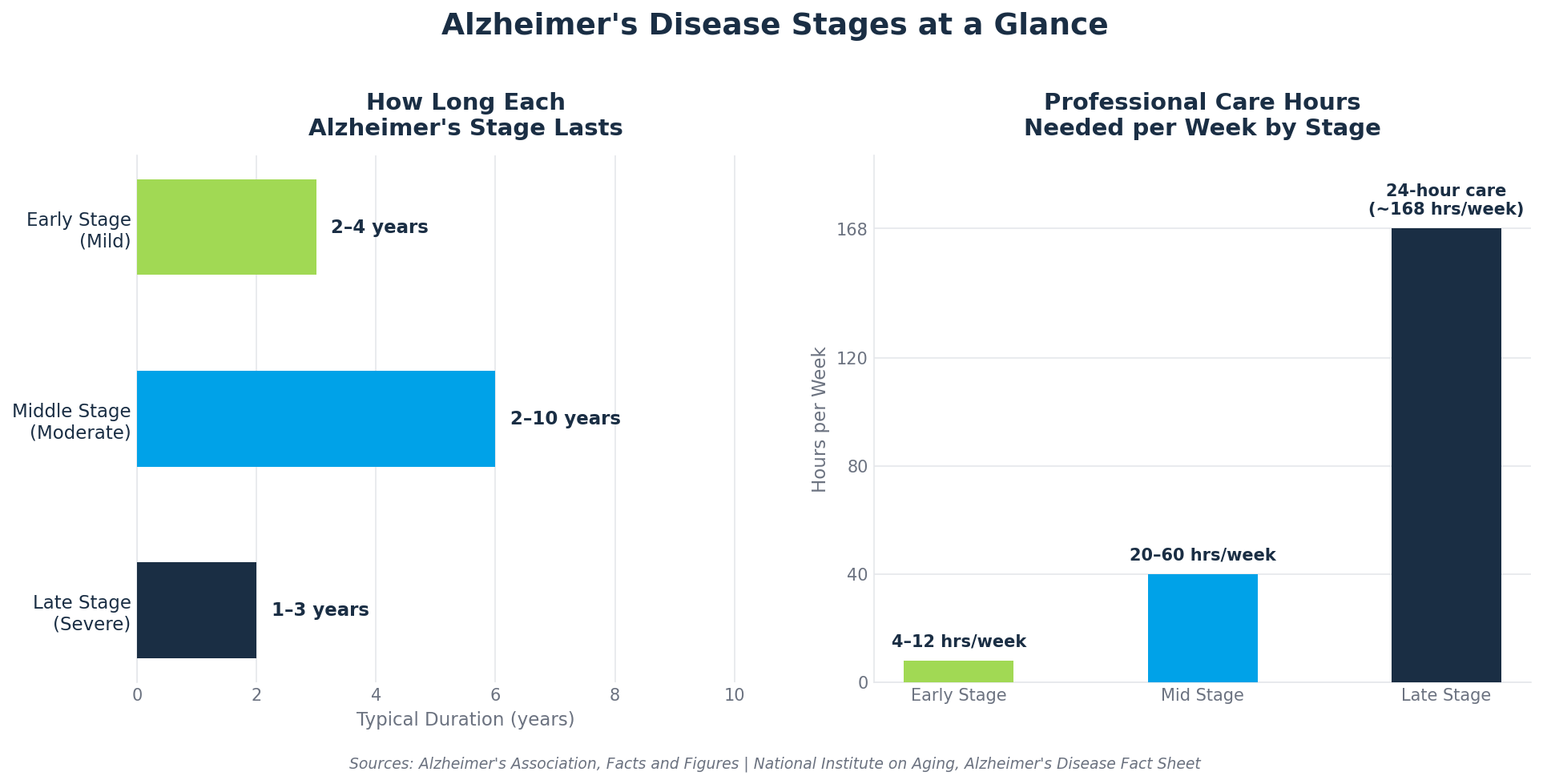
Early stage typically lasts 2–4 years. The person is largely independent but has memory lapses, occasional word-finding difficulty, and may need reminders for appointments and bills.
Priorities for early-stage care
- Establish legal authority. Power of Attorney (financial and healthcare), Living Will, and Will updated while capacity is intact. See our Pennsylvania POA guide.
- Confirm the diagnosis with a neurologist or geriatrician. MRI, cognitive testing, and review of all medications matter — some causes of “dementia” are treatable.
- Build a routine. Same wake time, meal times, walk time, bath time, bed time. Routine reduces anxiety in every stage.
- Use memory aids. Whiteboard with the day, date, and schedule. Pillbox with weekly slots and times. Phone reminders.
- Address driving early. The day Mom or Dad can no longer drive safely is coming — have the conversation before a crash forces it.
- Arrange social engagement. Senior centers, faith communities, walking groups. Isolation accelerates decline.
- Begin a respite habit for the primary caregiver, even if only 4 hours per week. Habits formed early save crises later.
Stage 2. Mid-stage Alzheimer’s at home
Mid-stage typically lasts 2–10 years and is the longest phase. The person needs hands-on help with daily activities, may not recognize family members reliably, and behavioral symptoms appear — sundowning, wandering, agitation, suspicion.
Communication that works
The Alzheimer’s Association provides specific communication guidance for mid-stage dementia (Alzheimer’s Association, Communication):
- Approach from the front, make eye contact, use the person’s name.
- Speak slowly and use short sentences.
- Ask one question at a time. Wait for the answer.
- Offer two choices, not open-ended decisions (“Do you want toast or oatmeal?” not “What do you want for breakfast?”).
- Don’t argue with delusions or false memories. Validate the feeling, redirect to a calmer topic.
- Use non-verbal cues — gentle touch, smiling, demonstrating tasks.
Daily care
- Bathing often becomes a battle. See our our guide on bathing a senior safely. A same-gender professional caregiver often eliminates resistance entirely.
- Dressing — lay out clothes in the order they go on. Stretch waistbands, slip-on shoes, no buttons.
- Eating — use plates with high-contrast color rims, finger foods when utensils become hard, smoothies and shakes when chewing fatigues. Watch for swallowing changes.
- Toileting — scheduled bathroom trips every 2 hours. Incontinence products as needed without making it a confrontation.
- Sleep — bright morning light, no caffeine after noon, consistent bedtime. See our guide on sundowning.
Safety
- Door alarms or motion sensors
- Stove auto-shutoff or remove stove knobs
- GPS tracking watch or pendant
- Lock medications, cleaning supplies, sharp objects
- Lock car keys away
- Enroll in MedicAlert + Safe Return through Alzheimer’s Association
- Notify neighbors so they recognize the person if found wandering
Behavioral symptoms
The most common are agitation, sundowning, repetitive questions, suspicion or accusation, refusal of care, and wandering. The Alzheimer’s Association recommends non-drug strategies first: identify and address physical needs (pain, hunger, bathroom, fatigue, overstimulation), then redirect with a familiar activity or object. Medications are sometimes added when behaviors compromise safety, but antipsychotics carry significant risks in dementia and require neurologist or geriatric psychiatrist oversight.
Caregiver burnout in mid-stage
Mid-stage is when family caregivers reach the limit of what one person can sustain. The Alzheimer’s Association reports dementia caregivers experience higher rates of depression, anxiety, and physical health decline than caregivers of people with other conditions (Alzheimer’s Association, Caregiving Resources). See our our caregiver burnout guide. Weekly respite is not optional — it is the difference between sustaining home care and being forced into facility placement.
Stage 3. Late-stage Alzheimer’s at home
Late stage typically lasts 1–3 years. The person needs full assistance with all daily tasks, communication is largely non-verbal, mobility is reduced, swallowing becomes difficult, and round-the-clock care is required.
Priorities for late-stage care
- Comfort first. Pain is often unrecognized in late-stage dementia. Watch for grimacing, guarding a body part, restlessness, or refusing to eat — these are pain signals.
- Skin integrity. Reposition every 2 hours to prevent pressure injuries. Inspect heels, tailbone, elbows daily.
- Hydration and nutrition. Pureed foods, thickened liquids if dysphagia is present (per swallow study). Small frequent feedings.
- Hygiene. Bed baths and barrier creams for incontinence.
- Mouth care. Twice-daily, even if eating is reduced — oral health prevents pneumonia.
- Music and touch. Familiar music from the person’s young adulthood reaches recognition long after speech is gone. Gentle hand-holding and presence matter.
- Hospice consideration. When ADL function is severely impaired, weight loss is significant, or recurrent infections occur, hospice eligibility likely applies. Hospice provides additional care hours, equipment, and family support and is fully covered by Medicare.
The role of professional home care across all stages
A-Team Home Care’s Alzheimer’s and dementia care program is built around four principles drawn from current dementia care best practices:
- Consistent caregiver assignment. Same caregiver every visit so the senior is not starting over with strangers.
- Trained dementia communication. Caregivers trained in redirection, validation, and non-verbal cues.
- RN supervision. An RN reviews each care plan and updates it as the disease progresses.
- Family partnership. Care plans are built around the family’s specific needs, with the agent under POA as primary contact.
Service intensity scales with stage:
- Early stage — 4–12 hours/week of companion care for activities, errands, and respite.
- Mid stage — 20–60 hours/week of personal care for ADLs plus evening or overnight coverage.
- Late stage — 24-hour home care with awake-shift caregivers, often coordinated with hospice.
Pennsylvania funding paths
- Pennsylvania Community HealthChoices Medicaid waiver covers most in-home dementia care for income-eligible seniors.
- VA Aid and Attendance for veterans and surviving spouses.
- Long-term care insurance if a policy was previously purchased.
- Family caregiver pay through A-Team’s Family Caregiver Program — eligible relatives are paid as W-2 caregivers.
- Hospice — fully covered by Medicare in late stage.
When facility placement becomes the right answer
Most Pennsylvania families avoid memory-care facility placement entirely with structured home care, but the threshold varies. Consider facility care when:
- Behavioral symptoms (combativeness, severe wandering, sexual disinhibition) cannot be managed safely at home
- The home environment cannot be made safe (multiple stairs, unsafe neighborhood for wandering)
- The family caregiver is no longer able to continue and 24-hour professional care exceeds budget
- The senior repeatedly states they do not want to be home or recognizes the home as foreign
Even families considering facilities often try a 2–4 week trial of intensive in-home support first — many find the original problem was caregiver burnout, not the senior’s needs.
Getting started with A-Team
For Philadelphia, Bucks County, and Montgomery County families, A-Team provides a free in-home assessment by an RN within 48 hours, a written care plan tailored to the dementia stage, and matching with consistent dementia-trained caregivers. Two PA offices: Philadelphia and Feasterville. ACHC-accredited.
Call (215) 490-9994 or email service@ateampa.com.
Frequently asked questions
Can someone with Alzheimer’s stay home through the entire disease?
For most families, yes — with the right support. Early stage requires modest help. Mid stage requires significant hands-on care, behavior management, and respite for family. Late stage requires 24-hour care, often coordinated with hospice. The barrier is rarely the disease itself; it is caregiver burnout and unsafe environments.
How do I keep my loved one with Alzheimer’s from wandering?
Door alarms, GPS tracking pendant or watch, MedicAlert + Safe Return enrollment, neighbor notification, and consistent supervision. If wandering happens more than once a week, an overnight or 24-hour caregiver is the right answer — family monitoring alone is not sustainable.
What’s the difference between Alzheimer’s and dementia?
Dementia is an umbrella term for cognitive decline severe enough to interfere with daily life. Alzheimer’s is the most common cause of dementia (60–80%). Other causes include vascular dementia, Lewy body dementia, frontotemporal dementia, and mixed types. Care principles overlap significantly across types.
Should I correct my parent when they say something inaccurate?
No. Correcting causes distress without improving understanding. The Alzheimer’s Association recommends “validation therapy” — acknowledge the feeling behind the statement and redirect. If your father says he needs to pick up the kids from school, do not say “the kids are grown.” Say “they’re at Grandma’s tonight, let’s have dinner first.”
Is there medication that helps Alzheimer’s?
Several medications (donepezil, rivastigmine, galantamine, memantine, and newer disease-modifying drugs) may modestly slow symptoms or progression in some patients. None reverse the disease. Discuss with the neurologist or geriatrician. Medication is one component of care — it does not replace structured home care.
What is the average life expectancy after Alzheimer’s diagnosis?
The Alzheimer’s Association reports an average of 4–8 years from diagnosis, but ranges from 3–20 years depending on age at diagnosis, overall health, and other conditions. Younger-onset Alzheimer’s (under 65) often progresses differently than late-onset.
Can A-Team caregivers manage difficult dementia behaviors?
Yes. A-Team’s dementia caregivers are trained in non-pharmacological behavior management, redirection, validation communication, and de-escalation. Consistent caregiver assignment is critical — behaviors typically reduce as the senior bonds with the same caregiver visit after visit.
Sources & further reading
- Alzheimer’s Association — Alzheimer’s Disease Facts and Figures
- Alzheimer’s Association — Caregiving Resources
- Alzheimer’s Association — Communication and Alzheimer’s
- National Institute on Aging — Alzheimer’s Disease Fact Sheet
- National Institute on Aging — Caregiving for a Person with Alzheimer’s
- National Institutes of Health — Alzheimer’s Information
- MedicAlert + Safe Return — Wandering Support Program
Medical disclaimer
This article is for general educational purposes and does not replace medical advice. Always consult the primary care physician, neurologist, or geriatrician for medical decisions in Alzheimer’s care. A-Team Home Care is an ACHC-accredited, RN-supervised home care agency serving Pennsylvania.
Related guides in this series: