
Melinda Piechoski, RN · Director of Nursing · Last updated May 5, 2026 · 12 min read
Medical disclaimer. This article provides general educational information. It is not medical advice. For care decisions specific to your loved one, call A-Team Home Care at (215) 490-9994 for a free RN assessment.
Why the bathroom is where falls happen
Falls are the leading cause of injury and injury death among adults aged 65 and older. The CDC reports that one in four older adults falls each year, and the bathroom is the room where the worst falls occur, wet surfaces, hard porcelain fixtures, narrow doors that block emergency response. The National Institute on Aging’s room-by-room fall prevention guide dedicates more attention to the bathroom than any other space, for that reason.
The good news: most bathroom falls are preventable with environmental changes that cost less than a single ER copay. The CDC’s STEADI initiative (Stopping Elderly Accidents, Deaths, and Injuries) gives clinicians a framework for assessing and reducing fall risk. STEADI’s home-modification checklist is the foundation of the list below, supplemented by the AARP HomeFit Guide and ADA grab-bar specifications.
The 23 changes, grouped by zone
Floor and traction (changes 1 to 4)
1. Replace the bath mat with a non-slip mat that has full-surface suction cups. Cheap mats slide under wet feet. A high-quality rubber mat with cups across the entire base does not.
2. Install non-slip strips or a textured mat inside the tub or shower base. The wet porcelain or fiberglass surface has roughly the friction of an ice rink for older skin. Adhesive strips solve the problem for under $20.
3. Remove or replace any throw rug on the bathroom floor with a low-pile, rubber-backed mat. Throw rugs are the single most-cited bathroom trip hazard in NIA fall-prevention literature.
4. Wipe up water immediately, every time. Keep a small microfiber towel hung at hand height beside the shower. The post-shower puddle has caused more hip fractures than any single architectural feature.
Tub and shower (changes 5 to 9)
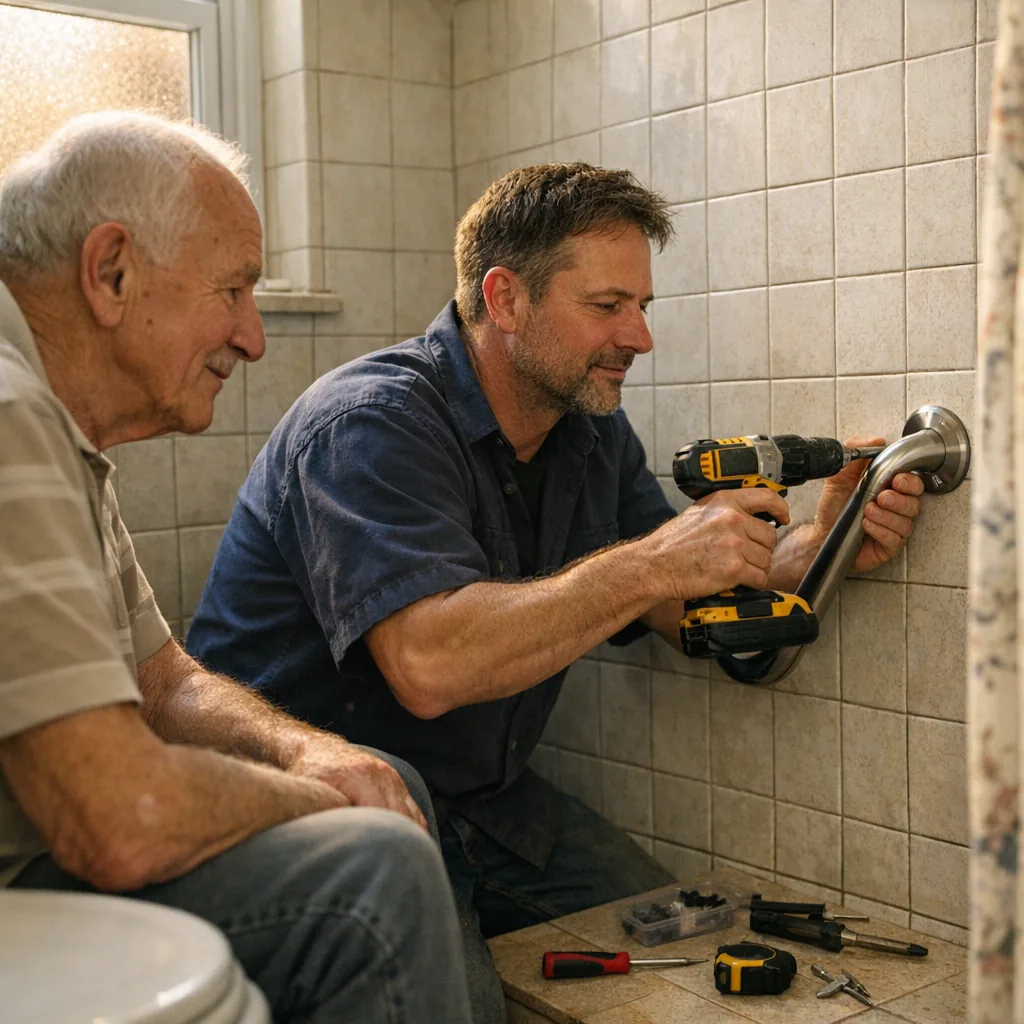
5. Install at least one wall-mounted grab bar inside the shower or tub, anchored into studs. Per the 2010 ADA Standards for Accessible Design (Section 609), grab bars must have a gripping surface 1¼ to 1½ inches in diameter, mount 33 to 36 inches above the finished floor, and support a minimum 250-pound point load. Stainless steel is the standard. Suction-cup bars are NOT a substitute: they fail under real load.
6. Install a vertical grab bar at the entry point to the tub or shower. The transition step is where most bathing falls occur. The vertical bar gives the senior something to pull against during the step.
7. Add a shower bench or transfer chair. Standing on wet feet for a 10-minute shower fatigues older legs. A chair eliminates the standing-balance failure mode entirely.
8. Replace the fixed shower head with a hand-held wand on a long hose. The senior can sit on the bench, control the spray, and wash without contortion.
9. Convert the tub to a curbless or low-threshold shower if the budget allows. The 14-inch step over a tub wall is the highest-risk movement in the home. Removing it removes the risk.
Toilet area (changes 10 to 13)
10. Install grab bars beside the toilet, one wall-mounted bar on the strong-arm side, ideally a second on the opposite wall or behind the tank. ADA toilet grab bars: 42 inches minimum on the side wall, 36 inches behind. Sit-to-stand transfers are the second most-common bathroom fall scenario.
11. Add a raised toilet seat (3 to 5 inches). Sitting down lower than the knees demands quad strength most seniors no longer have. The raised seat gives the hips a head start.
12. Place a small contrasting mat at the foot of the toilet so the senior can see the toilet base in low light. Vision-impaired seniors miss the bowl edge in monochrome bathrooms.
13. Keep the path to the toilet clear of trash cans, scales, and laundry baskets. The middle-of-the-night trip is the highest-fall-risk moment of the 24-hour day.
Lighting (changes 14 to 17)
14. Increase vanity light to 700 to 1,000 lumens, daylight color temperature. Older eyes need three to four times more light than younger eyes for the same visual acuity.
15. Add a motion-activated nightlight or floor-level light strip on the path from bedroom to bathroom. Eliminates the fumble for the wall switch.
16. Use a separate motion-activated light inside the bathroom that turns on automatically when the door opens. No reaching for a switch with one hand on the doorframe and one hand half-asleep.
17. Keep a flashlight in the bedside table for power outages. A power-outage bathroom trip in pitch dark causes a fall that the rest of the house was set up to prevent.
Grab bars (changes 18 to 19)
18. Have grab bars professionally installed into wall studs, never into drywall alone. A bar pulled off the wall mid-fall causes a worse injury than no bar at all. Hire a contractor, an OT-trained installer, or call your local Area Agency on Aging.
19. Choose a grab-bar finish your parent will actually accept. Modern brushed nickel and matte black finishes look like towel rails. Resistance to grab bars is largely aesthetic; resolving the aesthetic resolves the resistance.
Faucets and water (changes 20 to 22)
20. Replace round faucet knobs with single-lever or paddle handles. Arthritic hands cannot grip and rotate a small round knob. The lever takes one push.
21. Set the water heater to 120°F to prevent scald burns. The AARP home care resources and the American Geriatrics Society both flag scalds at 130°F+ as a serious senior burn risk.
22. Install an anti-scald (thermostatic mixing) valve in the shower. Older skin burns faster and recovers slower. The valve adds about $150 in parts and prevents a hospitalizable burn.
Communication (change 23)
23. Install a waterproof emergency-call button or keep a charged cell phone within arm’s reach of the toilet and shower. If the fall happens despite every other change, the time to first call for help determines the outcome. A senior who lies on the bathroom floor for six hours has worse outcomes than one who calls within ten minutes.
Don’t want to scroll back through all 23 items later?
Get the printable PDF checklist in your inbox, check off each change as you walk your parent’s bathroom.
Download the 23-point checklist →Decision points and how to call A-Team
Three changes deliver most of the safety improvement: grab bars at the toilet and shower, a shower bench with a hand-held wand, and motion-sensor nighttime lighting. If you can only do three, do those three. Then add the rest over a single weekend. If your parent has already fallen once, they are at significantly higher risk of falling again, per CDC older-adult falls data: act now.
A-Team Home Care performs in-home bathing assistance under an RN-supervised personal care plan, and our skilled nursing team can assess fall-risk medications and post-fall recovery. Companion care covers safety supervision for parents who can still do most ADLs but need someone present. For dementia patients, where bathroom risk multiplies, see dementia care. Adult children who first noticed the warning signs may also want to read our guide to the 8 signs your aging parent needs in-home care and our personal hygiene checklist for the elderly. Free RN assessment in Philadelphia, Bucks, Montgomery, Delaware, and Chester counties at (215) 490-9994.
Want this as a printable checklist? Get the free 23-Point Bathroom Fall-Prevention Checklist (PDF): sent to your email so you can print it and walk the bathroom with it in hand. The same tool A-Team’s intake nurses use during in-home assessments.
- Falls in older adults
- Leading cause of injury and injury death in adults 65+; 1 in 4 falls each year (CDC).
- Bathroom
- Highest-risk room in the home for senior falls; combination of wet surfaces and hard fixtures.
- Grab bar
- Wall-mounted safety device; ADA-compliant bars are 1¼ to 1½ inch diameter, 33 to 36 inches high, 250-pound load minimum.
- Aging in place
- Remaining safely in one’s own home through home modifications and in-home support services.
- Universal design
- Design philosophy for environments usable by all people regardless of age or ability.
- STEADI
- CDC’s clinical fall-prevention initiative: Stopping Elderly Accidents, Deaths, and Injuries.
- CDC STEADI
- cdc.gov/steadi: clinician-facing fall prevention toolkit
- NIA Falls Guide
- nia.nih.gov: preventing falls room by room
- AARP HomeFit
- aarp.org/HomeFit: aging-in-place home modification guide
- ADA Standards
- access-board.gov: 2010 ADA Standards for Accessible Design (grab bar specs)
- PA Dept of Aging
- aging.pa.gov: PA home modification programs
- A-Team Home Care
- Free RN home-safety assessment in PA: (215) 490-9994
- Topic
- Bathroom fall prevention for elderly adults
- Coverage area
- Philadelphia, Bucks, Montgomery, Delaware, and Chester counties (PA)
- Typical cost
- $300 to $800 for basic modifications; $5,000 to $15,000 for curbless shower conversion
- Funding sources
- PA Community HealthChoices waivers; Medicare Advantage OTC benefits; private pay; VetAssist
- Who it’s for
- Adult children of aging parents; older adults aging in place; family caregivers
- Time to implement
- Three highest-impact changes can be installed in one weekend
Frequently asked questions
What is the single most important bathroom safety upgrade for an elderly parent?
Grab bars by the toilet and inside the tub or shower, professionally installed into wall studs at 33 to 36 inches above the finished floor (per ADA). The CDC’s STEADI fall-prevention program lists bathroom grab bars among the highest-yield home modifications for older adults. Suction-cup bars are not a substitute, they pull off under real load. Budget $200 to $400 for two professionally installed stainless-steel bars.
Are walk-in tubs safe for seniors?
Walk-in tubs reduce the climb-over risk but introduce a different problem: the senior must sit inside the empty tub while it fills, then wait while it drains before exiting. Cold and slow. A barrier-free curbless shower with a bench, hand-held wand, and grab bars is generally safer and more practical for most older adults.
Does Medicare cover bathroom safety equipment?
Original Medicare does not cover grab bars, raised toilet seats, or shower benches under most circumstances. A bedside commode is sometimes covered as durable medical equipment. Medicare Advantage plans increasingly include over-the-counter benefit allowances that can be spent on bathroom safety items. Pennsylvania Medicaid waivers (Community HealthChoices) may cover home modifications for eligible adults.
Should we replace the bathtub with a curbless shower?
If the budget allows and the senior plans to age in place, yes, a curbless or low-threshold shower is the gold standard for bathroom safety. Most falls in the bathroom happen during the step in or out of a tub. A curbless shower with a built-in bench, hand-held wand, anti-slip flooring, and grab bars eliminates the highest-risk moment of the day.
How much do bathroom safety modifications cost in Pennsylvania?
Basic upgrades (grab bars, raised toilet seat, shower bench, anti-slip strips) run $300 to $800 installed. A walk-in shower conversion runs $5,000 to $15,000 depending on plumbing and tile. Pennsylvania residents may qualify for help through the PA Department of Aging’s home modification programs and Community HealthChoices waivers. Call A-Team Home Care at (215) 490-9994; we coordinate with regional aging agencies.
My parent refuses grab bars because they look like ‘old-people stuff.’ What do I say?
This is the most common objection. Reframe: the bar is for guests and grandchildren, the bar protects the equity in the home (a hospital admission for a hip fracture costs the family more than the house repair), and modern stainless or designer-finish bars look like towel rails. Show them a few finishes online. Resistance usually drops once they see the 2026 styling, not the 1985 hospital style.
What lighting does a senior bathroom actually need?
Bright, glare-free, and on a motion sensor for the nighttime trip. Aim for 700 to 1,000 lumens at the vanity and at least 400 lumens above the toilet and shower. A nightlight or motion-sensor floor light on the path between bedroom and bathroom prevents the 2 a.m. fall, which is statistically the most dangerous moment of the senior bathroom day.
Does A-Team Home Care help with bathing if my parent has fallen before?
Yes. After a fall, or before one happens, A-Team’s home health aides assist with bathing, transfers in and out of the shower, dressing, and grooming under an RN-supervised plan. Care is delivered in Philadelphia, Bucks, Montgomery, Delaware, and Chester counties. Free RN assessment at (215) 490-9994.
Sources & further reading
- CDC STEADI: Stopping Elderly Accidents, Deaths, and Injuries
- National Institute on Aging: Preventing Falls at Home: Room by Room
- CDC: Older Adult Falls Data
- AARP HomeFit Guide: Aging in Place Home Modification Guide
- AARP: AARP home care resources
- U.S. Access Board: 2010 ADA Standards for Accessible Design (grab bar specs, Section 609)
- American Geriatrics Society: Falls prevention guidelines
- A-Team Home Care: Personal Care
- A-Team Home Care: Skilled Nursing
Disclaimer
This article provides general educational information about bathroom safety modifications and is not medical advice. Always consult a physician or licensed contractor before structural changes. A-Team Home Care is an ACHC-accredited home care agency serving Pennsylvania.
Contact us
Reach out and let us know how we can help. We will reply quickly with the information you need or to schedule a free in-home RN assessment.
A-Team Home Care is an ACHC-accredited home care agency licensed in Pennsylvania. Services are delivered in Philadelphia, Bucks, Montgomery, Delaware, and Chester counties.
Follow A-Team on Instagram
Real moments from real shifts: caregivers, clients, milestones, team events. @ateamhomecare · updated weekly.