

Melinda Piechoski, RN · Director of Nursing · Last updated May 5, 2026 · 12 min read
Medical disclaimer. This article provides general educational information about adult day services and in-home care in Pennsylvania. It is not medical, legal, or insurance advice. Coverage, pricing, and eligibility rules change, verify current details with your Community HealthChoices managed care organization, the PA Department of Human Services, or your local Area Agency on Aging. For care decisions specific to your loved one, call A-Team Home Care at (215) 490-9994 for a free RN-led assessment.
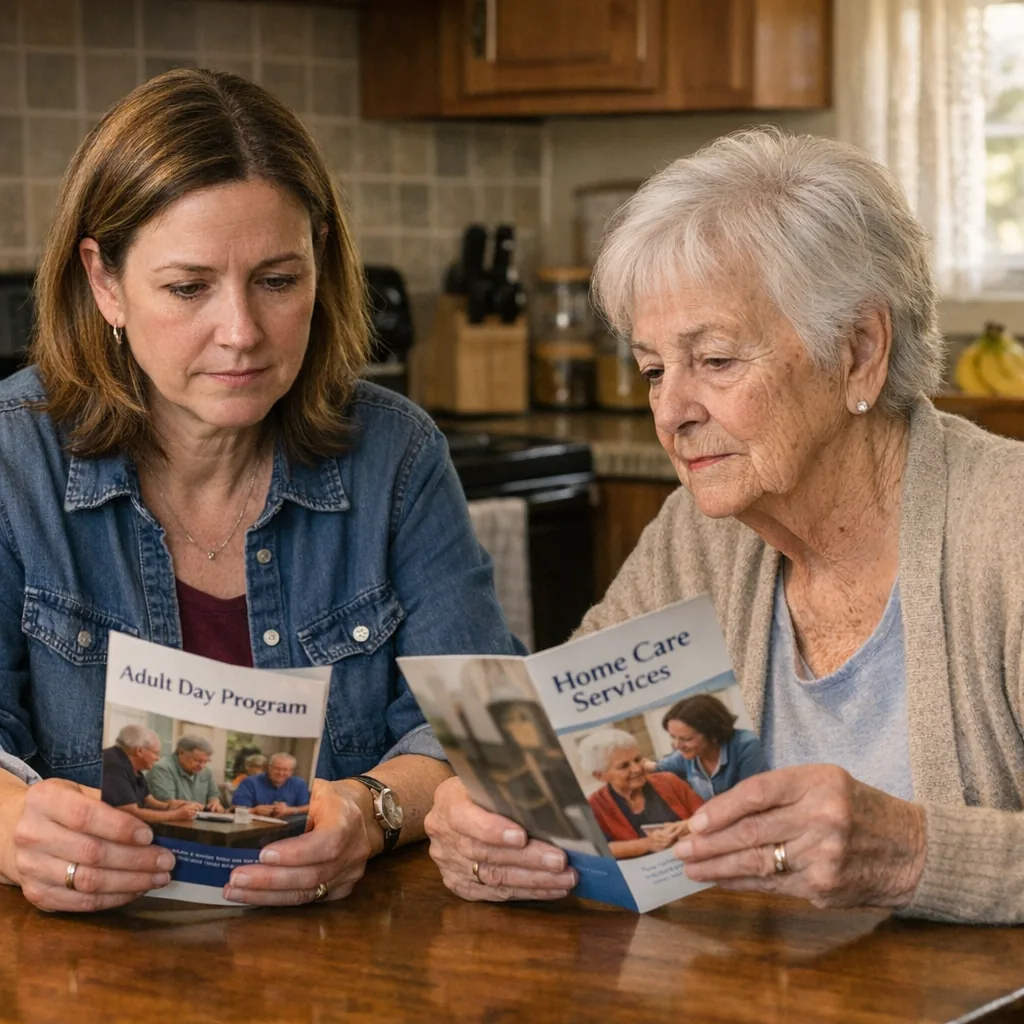
The decision the family is actually making
Most families do not start by comparing adult day services to in-home care in the abstract. They start with a problem. A parent who can no longer be left alone safely. A family caregiver running out of bandwidth between work and bedside. A hospital discharge that requires daytime supervision the family cannot cover. A Community HealthChoices waiver that finally approves long-term services. The choice between adult day and in-home care is downstream of the actual problem the family is trying to solve.
Both options exist on the same continuum: care that lets an older adult stay out of a nursing facility. The federal Medicaid Home and Community-Based Services (HCBS) program funds both, and Pennsylvania administers them through the Community HealthChoices managed care program [PA DHS verified 2026-05-05]. The Medicare.gov: long-term care coverage (adult day health care) notes that traditional Medicare does not pay for adult day services, coverage comes from Medicaid, long-term care insurance, VA programs, or out-of-pocket [Medicare.gov verified 2026-05-05]. The National Council on Aging: adult day care costs and alternatives to assisted living consistently shows adult day services as one of the most cost-effective long-term-care options, typically half the daily cost of home health aide hours [NCOA verified 2026-05-05].
Side-by-side comparison: adult day vs A-Team in-home care
This is the table most families wish they could find. It compares adult day services (both social and medical models) against A-Team in-home care across the seven dimensions that actually drive the decision.
| Dimension | Adult Day (Social) | Adult Day (Medical / ADHC) | A-Team In-Home Care |
|---|---|---|---|
| Typical PA cost | ~$80 to $100 per day [NCOA verified 2026-05-05] | ~$100 to $150 per day; varies by program [NCOA verified 2026-05-05] | ~$30 to $36 per hour personal care; 24-hour care negotiated separately [A-Team verified 2026-05-05] |
| Hours / schedule | Weekdays, ~8 a.m. to 4 p.m.; full or half day | Weekdays, ~7 a.m. to 5 p.m.; full or half day | Any block, 4-hour minimum visit; 24/7 including overnights, weekends, holidays |
| Dementia suitability | Early-stage often thrives; mid-to-late stage may struggle with group setting | Better fit through mid-stage if program is dementia-specific; behaviors may still travel poorly | Best fit for mid-to-late stage, sundowning, wandering, or behavioral symptoms, one-on-one in familiar environment |
| Transportation | Center provides door-to-door or coordinates Shared Ride; daily round-trip required | Center provides; medical-model often has wheelchair-equipped vans | None: aide comes to the home |
| Social engagement | Strong: group activities, peer relationships, structured day | Strong: group setting plus clinical structure | One-to-one only; aide can take parent on outings, to senior center, or to faith services |
| Nights & weekends | Not covered: family or in-home care must fill the gap | Not covered: family or in-home care must fill the gap | Fully covered: overnight, weekend, holiday, and 24-hour shifts available |
| CHC Medicaid coverage | Covered for CHC participants who qualify clinically and financially [PA DHS verified 2026-05-05] | Covered when ordered by the participant’s care plan [PA DHS verified 2026-05-05] | Covered as personal assistance services for CHC participants; A-Team is in-network with all three CHC MCOs [A-Team verified 2026-05-05] |
Read the table by row, not by column. The right answer for your family is the row where adult day or in-home covers your single biggest gap, the gap that, if it is filled, the rest of the plan holds together.
What adult day services actually look like
Pennsylvania licenses two flavors of adult day. The social model (sometimes called Older Adult Daily Living Centers) provides supervision, meals, and structured activities for older adults who are largely independent in basic self-care but should not be home alone all day. The medical model (Adult Day Health Care, ADHC) adds a registered nurse on site, medication oversight, and often physical, occupational, or speech therapy, designed for adults with chronic conditions and stable trajectories.
A typical day starts with a van pickup between 7:00 and 9:00 a.m., a morning snack and welcome circle, a structured activity block (memory exercises, gentle movement, music, art, or current events), a hot lunch, an afternoon activity or outing, and a 3:00 to 5:00 p.m. drop-off back home. Most centers operate Monday through Friday. Saturday programs exist but are rare in the Philadelphia region.
Adult day suits the senior who once thrived in groups, the church-coffee-hour parent, the lunch-bunch parent, the grandparent who told stories at every reunion. The group structure gives them an audience and a reason to dress for the day. Families also report that adult day creates one of the strongest forms of caregiver respite available, because it is predictable and full-day. You drop off at 8 a.m., go to work, and pick up at 4 p.m. with the day already covered.
What A-Team in-home care looks like
A-Team Home Care delivers care in the parent’s own home or apartment. Our services include personal care (bathing, dressing, toileting, transfers, meal prep), companion care (supervision, errands, conversation, medication reminders), skilled nursing, dementia care, respite, and 24-hour or overnight coverage. The aide comes to the home; the parent never has to leave. Visits run a 4-hour minimum and scale up to 24/7 care depending on what the family needs.
In-home care suits the parent who values privacy, the senior who is anxious in unfamiliar settings, the dementia patient whose behaviors travel poorly to group environments, and any family where transportation logistics are the bottleneck. It is also the only option for nights, weekends, and 24-hour coverage, the hours adult day cannot reach.
A-Team caregivers are W-2 employees of the agency, not contractors, and we pay bi-weekly. We are an ACHC-accredited Pennsylvania home care agency serving Philadelphia, Bucks, Montgomery, Delaware, and Chester counties, in-network with all three Community HealthChoices managed care organizations.
How Pennsylvania’s Community HealthChoices (CHC) waiver actually works
Pennsylvania moved most long-term services for older adults and adults with physical disabilities into Community HealthChoices in a phased rollout from 2018 to 2020 [PA DHS verified 2026-05-05]. CHC is a managed care program. Three managed care organizations administer it statewide:
- Keystone First Community HealthChoices (AmeriHealth Caritas)
- UPMC Community HealthChoices
- PA Health & Wellness (Centene)
To enroll, your parent must qualify both clinically (a Nursing Facility Clinically Eligible determination through the Independent Enrollment Broker, Maximus) and financially (Medical Assistance income and asset rules; the 2026 figures are published annually by PA DHS). Once enrolled, the participant works with a CHC service coordinator who builds a person-centered service plan. Adult day services and personal assistance services (the formal name for in-home personal care) are both covered benefits under that plan when the assessment supports them.
Many CHC participants combine both. A typical plan looks like adult day three or four weekdays for daytime supervision and respite, plus a few hours of in-home care on the other days for personal care, evening support, or weekend coverage. The CHC service coordinator authorizes the hours; A-Team and the adult day center bill the MCO directly. Out-of-pocket cost to the family is zero for covered services in the plan.
For families not yet on CHC, the path is: contact your local Area Agency on Aging, request a long-term services assessment, and apply for Medical Assistance through your county assistance office or COMPASS at compass.state.pa.us. The Independent Enrollment Broker walks families through the steps. Approval typically takes 60 to 120 days [PA DHS verified 2026-05-05]; many families bridge with private-pay in-home care during the wait.
A decision framework
Use these four scenarios to map your situation to the right starting point.
Scenario 1: socially engaged, ambulatory, weekday respite needed. Start with adult day three to four days per week. Layer in a few hours of in-home care for evenings or weekends if the working caregiver still has gaps.
Scenario 2: mid-to-late dementia, behavioral symptoms, or transportation difficulty. Start with in-home care, scaled to the hours required. The familiar environment, one-on-one ratio, and continuity of caregiver matter more than group activity at this stage. Add overnight or 24-hour coverage if night supervision is the actual problem.
Scenario 3: post-hospital, complex medication, wound care, or skilled clinical needs. In-home skilled nursing from an RN-supervised plan is the right starting point. Step down to personal care and (later) adult day once the parent is medically stable.
Scenario 4: the family caregiver is the bottleneck. Burning out, missing work, sleeping in the parent’s house six nights a week. Engage A-Team’s Family Caregiver Program: a Pennsylvania program that lets eligible family members get paid (bi-weekly) for the hours they already provide. Combining family hours with paid hours often gives the best coverage at the lowest total cost.
How A-Team Home Care fits into either path
A-Team is a home care agency, not an adult day center. We handle the in-home portion of any plan, personal care, companion care, skilled nursing, dementia care, 24-hour and overnight coverage, respite care, and our Family Caregiver Program. When adult day is the right primary fit, we refer families to vetted Pennsylvania adult day centers in their county and coordinate the in-home hours that fill the rest of the week. Many of our families use both: adult day weekdays, A-Team weekends and evenings.
A free RN-led assessment is the fastest way to find out what your situation actually needs. The assessment is conducted in the home, takes about 60 minutes, and produces a written care plan you can use whether you ultimately work with us or not. Call (215) 490-9994.
| Adult day cost (PA, social) | ~$80 to $100/day |
| Adult day cost (PA, medical/ADHC) | ~$100 to $150/day |
| A-Team in-home (PA) | ~$30 to $36/hour personal care |
| CHC Medicaid waiver | Covers both for eligible adults |
| CHC managed care orgs | Keystone First, UPMC, PA Health & Wellness |
| A-Team caregiver pay | Bi-weekly, W-2 |
Adult day services are community-based programs providing daytime supervision, meals, activities, and (in the medical model) clinical oversight for older adults who need more than they can get at home alone, but less than residential placement. Pennsylvania licenses two models: Older Adult Daily Living (social) and Adult Day Health Care (medical).
In-home care is non-medical or skilled care delivered in the recipient’s home by an aide, companion, or nurse. It scales from a few hours per week to 24/7 coverage and is the only option for nights, weekends, and holiday hours.
Community HealthChoices (CHC) is Pennsylvania’s Medicaid-funded managed long-term services and supports program for adults 21+ who are dually eligible for Medicare and Medicaid, or who need a nursing-facility level of care. CHC funds both adult day services and in-home personal assistance services through three managed care organizations.
Frequently asked questions
Is adult day care covered by Pennsylvania Medicaid?
Yes, in many cases. Pennsylvania’s Community HealthChoices (CHC) waiver covers adult day services for clinically and financially eligible older adults and adults with physical disabilities through Keystone First Community HealthChoices, UPMC Community HealthChoices, and PA Health & Wellness [PA DHS verified 2026-05-05]. Eligibility requires a Nursing Facility Clinically Eligible determination plus Medical Assistance income and asset qualification. Apply through your local Area Agency on Aging or the Independent Enrollment Broker (Maximus).
How much does adult day care cost in Pennsylvania?
Adult day services in Pennsylvania run roughly $80 to $100 per day for full-day social-model attendance and $100 to $150 per day for medical-model (ADHC) programs, depending on the program and clinical level [NCOA verified 2026-05-05]. Lunch, snacks, activities, and often transportation are included. Compare to in-home personal care averaging $30 to $36 per hour in the Philadelphia metro region.
What’s the difference between social adult day and medical adult day?
Social adult day programs (Older Adult Daily Living Centers in PA) focus on activities, meals, and supervision for older adults who do not need clinical care during the day. Medical adult day (Adult Day Health Care, ADHC) adds an on-site RN, medication oversight, therapy services, and care for adults with chronic conditions. PA licenses both. The choice depends on clinical needs.
Can my parent attend adult day and still get A-Team home care?
Yes, and many of our families do exactly this. Adult day three or four weekdays for social engagement and supervision, plus a few hours of A-Team in-home care on the other days for personal care, errands, evening support, or weekend coverage. Pennsylvania CHC plans authorize both services in the same person-centered plan when the assessment supports it.
What if my parent refuses to go to adult day?
Resistance is common at the start. The brain that has been at home alone for two years will not happily switch to a group setting in week one. Most centers offer a one-day trial. Frame it as a club or activity, not a placement. After three or four visits, most older adults form a relationship with one staff member or peer that pulls them back. If resistance continues past 30 days, in-home care is usually the better fit and dignity-preserving choice.
Does adult day care provide transportation?
Most Pennsylvania adult day centers either provide door-to-door transportation directly or coordinate it through county Shared Ride programs (Shared Ride is a PA Lottery-funded program for older adults). Ask the center about pickup zones and times before enrolling. Transportation logistics often determine which center is realistic for a given family.
My parent has dementia. Is adult day or in-home care better?
It depends on the stage. Early-stage dementia patients often thrive in adult day’s structured group setting, the routine and engagement actually help slow decline and reduce agitation. Mid-stage patients may need a dedicated dementia-specific adult day program with smaller groups and trained staff. Late-stage patients with significant ADL dependence, wandering, or behavioral symptoms typically do better with in-home dementia care, including overnight or 24-hour coverage in their familiar environment.
Does Medicare pay for adult day services or in-home care?
Traditional Medicare does not pay for adult day services and pays for in-home care only in narrow circumstances, intermittent skilled nursing or therapy following a qualifying event, ordered by a physician [Medicare.gov verified 2026-05-05]. Long-term, non-skilled in-home care is not a Medicare benefit. The funding paths for adult day and ongoing in-home care are: Medicaid (CHC in PA), long-term care insurance, VA Aid & Attendance for eligible veterans, or out-of-pocket.
How does A-Team Home Care help families decide?
A-Team’s RN-led intake team conducts a free in-home assessment that maps clinical complexity, social fit, family caregiver bandwidth, transportation, schedule, and budget, and recommends in-home care, adult day, or a combination. We provide the in-home portion and refer families to vetted PA adult day centers when adult day is part of the right answer. Free assessment: (215) 490-9994.
Sources & further reading
- PA Department of Human Services: Community HealthChoices
- Medicare.gov: Medicare.gov: long-term care coverage (adult day health care)
- National Council on Aging: National Council on Aging: adult day care costs and alternatives to assisted living
- Medicaid.gov: Home and Community-Based Services (HCBS)
- PA Department of Aging: Area Agencies on Aging
- PA COMPASS: Apply for Medical Assistance
- A-Team Home Care: Services | Personal Care | Companion Care | Skilled Nursing | Family Caregiver Program
- A-Team Home Care: Paid Family Caregiver Pennsylvania: 7 Steps to First Paycheck
- A-Team Home Care: VetAssist & Aid & Attendance: PA Veterans’ Guide to Free Home Care Hours
- A-Team Home Care: PA Veterans Benefits Beyond VetAssist
Contact us
Tell us about your loved one. An A-Team RN will follow up the same business day with a free assessment and a written care plan, whether the right answer is adult day, in-home care, or a combination of both.
A-Team Home Care is an ACHC-accredited Pennsylvania home care agency, in-network with Keystone First Community HealthChoices, UPMC Community HealthChoices, and PA Health & Wellness. Serving Philadelphia, Bucks, Montgomery, Delaware, and Chester counties.
Follow A-Team on Instagram
Real moments from real shifts: caregivers, clients, milestones, team events. @ateamhomecare · updated weekly.