
Home health aides for medically fragile children help families do something hard: keep a child with complex medical needs safe, comfortable, and at home. When a child has serious health needs, the work of care never really stops. Medications, feeding routines, equipment checks, appointments, and short nights all fall on a few people, and most of them are parents who are also trying to be parents. The right aide takes part of that weight.
This guide from A-Team Home Care, a licensed home care agency serving Philadelphia, Bucks County, and the surrounding Pennsylvania counties, explains what an aide does for a medically fragile child, where nursing takes over, what to ask an agency, how Medicaid’s EPSDT benefit can pay, and how fast care can start. It is written for parents and guardians early in the search who want plain, honest information.
What “Medically Fragile” Means and Where an Aide Fits
“Medically fragile” is a practical term, not a single diagnosis. It is used for children who live with serious, ongoing health conditions and who may depend on medical equipment, a careful daily routine, or close monitoring to stay well. Some children have a tracheostomy or use a ventilator or BiPAP at home. Some have a G-tube or continuous feeds. Some have seizure disorders, cerebral palsy, or a genetic condition, and some are coming home from a hospital or NICU stay. A child does not need a confirmed diagnosis to qualify for pediatric home care; the qualifier is the child’s documented medical or functional need.
In that picture, a home health aide is the person who helps with day-to-day care. The aide is not the child’s doctor and is not a substitute for the nursing team. The aide is a steady, trained presence who helps with the hands-on routines of the day: personal care, comfort, safety, mobility help, meals, and companionship. The aide also notices things. A change in appetite, mood, skin, breathing, or energy is often seen first by the person who spends the most hours with the child, and a good aide reports it right away.
If you are new to in-home help, our overview of home health care explains how the different kinds of support fit together, and our pediatric home care page describes the full service A-Team provides for medically complex children.
What a Home Health Aide Does, and What Belongs to a Nurse
The most useful thing a family can learn early is the line between aide tasks and nursing tasks. In Pennsylvania, as in other states, certain procedures are reserved for licensed nurses. An aide works within a defined scope and follows the plan of care set by the family and the child’s medical team.
Tasks that fall within the usual role of a home health aide include:
- Bathing, dressing, and grooming, done gently and with attention to the child’s comfort and dignity.
- Help with toileting and diapering.
- Meal preparation and help at mealtimes, following the feeding approach the family and medical team have set.
- Safe lifting, repositioning, and transfers according to the care plan.
- Routine support so the household stays on schedule.
- Light housekeeping tied to the child’s care, such as laundry and keeping the child’s space clean and safe.
- Companionship, play, reading, and quiet time, which matter as much as any task on the list.
Tasks that belong to a licensed nurse include assessments, medication administration, tracheostomy suctioning and ventilator support, G-tube and continuous feeds, seizure protocols, and wound care. At A-Team, those are handled by private-duty RNs and LPNs, one nurse per child for the full shift. Personal care for children who do not need a nurse is provided by state-trained aides under RN supervision. Many families use both: a nurse for the clinical hours and an aide for the daily-care hours. Our private duty nursing page explains the nursing side in more detail, and if your child has a wound or skin concern, our article on wound care at home and when to call a home health nurse explains when a nurse needs to be involved.
What a Good Day of Care Can Look Like
Every child is different, so every plan is different. Still, it helps to picture how an aide fits into a typical day, so you can think about where support would help your household most.
In the morning, an aide might help a child wake up, get washed and dressed, and settle in for breakfast, following the routine the parents have laid out. This is often the hardest stretch of the day, because everything needs to happen at once. Extra hands here can mean a parent gets to work on time, gets another child to school, or simply eats breakfast sitting down.
During the day, the aide keeps the child comfortable and engaged. That might mean reading together, playing, doing gentle activities suited to the child’s abilities, or helping with the exercises the therapy team has recommended. The aide keeps the space safe and watches for changes. Families often tell us that having a dependable adult in the home is its own kind of relief.
In the afternoon and evening, the aide can help with meals, bath time, and the routine that leads toward bed. Some families need only a few hours at key times of day. Others need longer coverage, and our 24-hour home care page explains how rotating caregiver shifts can cover up to 24 hours per day.
How to Choose an Agency: Questions Worth Asking
Choosing who comes into your home to care for your child is a serious decision. Do not feel rushed, and do not feel awkward about asking direct questions. A reputable agency expects them.
- Does the agency serve children, and which needs? Not every home care agency is set up for pediatric care. Ask plainly whether it can meet your child’s specific needs, and expect an honest answer.
- Who supervises the aides? For a medically fragile child, ask whether a registered nurse writes the plan of care and supervises the aides.
- What will the aide do and not do? Ask for the scope of services in writing so everyone shares the same understanding.
- How are caregivers screened and trained? Ask what background checks and pediatric training happen before a caregiver is placed in a home.
- What happens if the regular caregiver is out? Reliability matters when a child depends on a routine.
- Is the agency licensed and accredited? Our article on what ACHC accreditation means for home care explains what to look for.
It is also fair to ask to meet the caregiver before care begins. Watching how they speak to your child, and how they listen to you, tells you more than any brochure can. Reading what other families say helps too; our A-Team reviews page collects them in one place.
How Pediatric Home Care Starts at A-Team
A-Team Home Care has served families in Philadelphia and Bucks County since 2016. For medically complex children, the process on our pediatric home care page has four steps:
- Free phone consultation. Call (215) 490-9994. A pediatric care coordinator listens to the child’s diagnosis, the current specialist team, and the family’s day, and tells you the right payer route on the first call.
- In-home RN assessment. A pediatric registered nurse visits the home within 48 hours, reviews the orders, and builds a plan of care around the child’s needs.
- Nurse and aide match. A-Team assigns pediatric-trained nurses and aides matched to the child’s needs and schedule, with consistency as the priority.
- Care begins. Care starts on the authorized schedule, with the RN coordinating directly with the child’s physicians and hospital team.
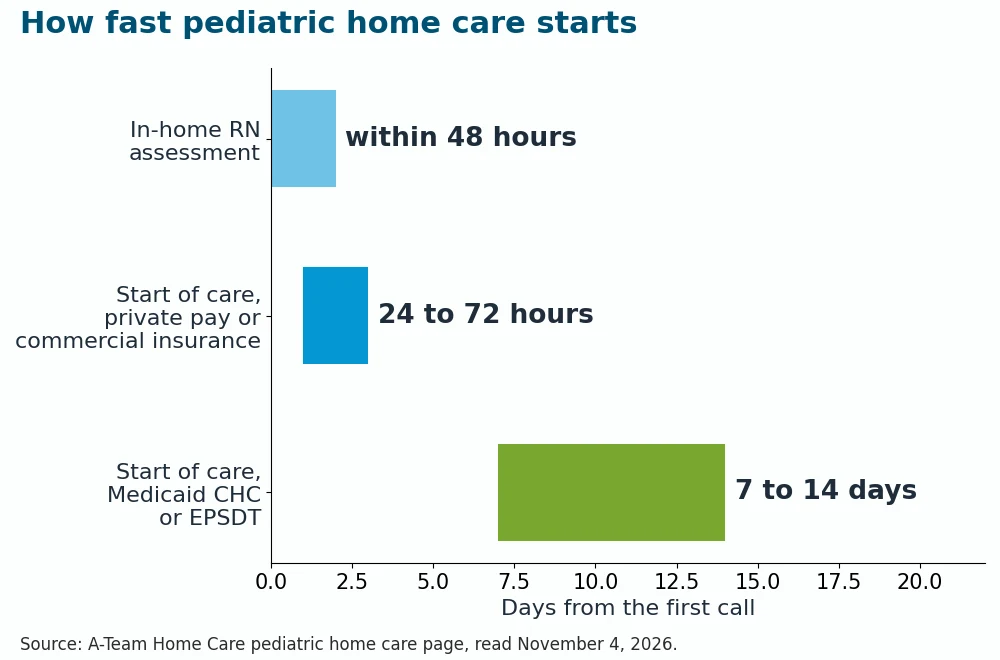
The timing depends on how care is paid for. When Medicaid CHC or EPSDT is billed, care typically starts in 7 to 14 days. For private pay or commercial insurance with prior authorization in hand, it is typically 24 to 72 hours. Our community recognition includes the Philadelphia Inquirer Philly Favorites, a Top 20 place on the Philadelphia100 in 2025, and Best of Bucks Senior Care on the 2025 Bucks Happening List. We are proud of that, but we measure ourselves by whether the child at home is safe and comfortable and the family can breathe again.
Working With the Medical Team
A child with complex needs usually has more than one professional involved: a pediatrician, specialists, therapists, and often a home health nurse. The aide’s job is not to replace any of them but to carry out the daily plan consistently and be an extra pair of eyes. A few habits make this work well:
- Write the routine down. A clear care plan in a shared place keeps every caregiver consistent, including backup caregivers.
- Keep a short daily log. Notes on meals, mood, sleep, and anything unusual help the next shift and help you when you talk to doctors.
- Agree on what to report. Decide with your medical team which changes should trigger an immediate call to you, and tell the aide.
- Know the emergency plan. Every caregiver in the home should know where emergency information is kept and whom to call first.
- Ask questions freely. A good aide welcomes clear instructions and would rather ask than guess.
Parents remain the experts on their child. The best aides follow the family’s lead and learn the small things that make a child feel secure, like a favorite song, a particular way of being held, or the order of a bedtime routine.
Supporting the Whole Family
Caring for a medically fragile child affects everyone in the household. Parents often run on very little sleep. Brothers and sisters may feel overlooked even when they understand why. Reliable help at home is not a luxury in this situation. It is part of keeping a family healthy enough to keep going.
When an aide is in the home, a parent may be able to sleep, go to a sibling’s school event, or take a short walk. Those moments are what allow a parent to keep showing up for the long haul. Planned breaks are what respite care is for: hourly, overnight, or full-day relief so parents can sleep, work, or care for their other children. If your child’s needs center on autism, our autism home care page covers that support.
Paying for Care in Pennsylvania
Cost is often the first worry, and for many families the answer is better than they expect. Medicaid.gov describes the Early and Periodic Screening, Diagnostic, and Treatment (EPSDT) benefit as health care for children under age 21 who are enrolled in Medicaid, covering preventive, dental, mental health, and specialty services, and says states are required to furnish all Medicaid coverable, appropriate, and medically necessary services needed to correct and ameliorate health conditions. A-Team’s team works with the EPSDT and Medicaid waiver routes that cover pediatric home care, so most families pay nothing out of pocket.
To apply for Medicaid or CHIP in Pennsylvania, start with the Pennsylvania Department of Human Services, which takes applications through COMPASS. Your child’s care coordinator or social worker can also point you to the right program. For the general rules on who can receive in-home help, see our guide on who qualifies for home health care services, and for how the two big public programs differ, read Medicare versus Medicaid for home care in Pennsylvania.
There is one more route many parents do not know about. In Pennsylvania, a parent, grandparent, or sibling age 18 or older can often be hired and paid as the child’s caregiver through the Family Caregiver Program and self-directed Medicaid waivers. For veteran households, A-Team is an enrolled VetAssist provider and handles the VA application at no cost; our veterans home care page explains how that works.
Talk to A-Team Home Care about your child’s care.
Frequently Asked Questions
What does a home health aide do for a medically fragile child?
A home health aide helps with daily care such as bathing, dressing, toileting, meals, safe repositioning, comfort, and play, following the plan of care set by the family and the child’s medical team. At A-Team, pediatric aides work under registered nurse supervision. An aide does not replace a nurse or doctor.
Can a home health aide handle a trach, ventilator, or feeding tube?
Those tasks belong to the nursing side of the plan. At A-Team, trach and ventilator care, G-tube and continuous feeds, medication administration, and seizure protocols are handled by private-duty RNs and LPNs. Aides cover hands-on daily care for children who do not need a nurse for that part of the day.
Does Medicaid pay for home care for a child with complex medical needs?
Often, yes. Medicaid.gov says the EPSDT benefit covers children under age 21 who are enrolled in Medicaid, and that states must furnish medically necessary services needed to correct or ameliorate health conditions. A-Team works with the EPSDT and Medicaid waiver routes, so most families pay nothing out of pocket.
How fast can pediatric home care start?
A-Team’s pediatric home care page lists an in-home RN assessment within 48 hours. Care typically starts in 7 to 14 days when Medicaid CHC or EPSDT is billed, and in 24 to 72 hours for private pay or commercial insurance with prior authorization in hand.
Can a parent be paid to care for their own medically fragile child?
In Pennsylvania, a parent, grandparent, or sibling age 18 or older can often be hired and paid as the child’s caregiver through the Family Caregiver Program and self-directed Medicaid waivers. Eligibility depends on the child’s coverage and needs, so ask about it on the first call.
How do I know if an agency is the right fit for my child?
Ask whether the agency serves children, which needs it can meet, whether a nurse supervises the aides, how caregivers are screened and trained, and what happens when the regular caregiver is out. A trustworthy agency answers plainly, including telling you when your child needs a different kind of provider.
If your family needs steady, kind help at home for a medically fragile child, we would be glad to talk. A-Team Home Care serves Philadelphia, Bucks County, and the surrounding Pennsylvania counties. Call (215) 490-9994, tell us about your child and your household, and we will give you an honest answer about how we can help.