

When a parent starts needing help at home, one of the first questions families ask is how much help is enough. Should a caregiver come for a few hours a day, or should someone be in the house around the clock? Choosing between hourly care and live in care affects your parent’s safety, your family’s budget, and everyone’s peace of mind. This guide from A-Team Home Care, a licensed home care agency serving Philadelphia, Bucks County, and the surrounding Pennsylvania counties, explains how each option works, who tends to do well with each, what they cost, and when it is time to change the plan.
What Hourly Care Looks Like Day to Day
Hourly care means a caregiver comes to your parent’s home for a set block of time. That might be a couple of hours in the morning to help with bathing and breakfast, an afternoon visit for meals and company, or an evening shift to help with dinner and getting ready for bed. You choose the days and the length of each visit, and you can change the schedule as needs shift.
What happens during a visit depends on your parent. Many families start with companion care, which focuses on conversation, meals, light housekeeping, reminders, and a steady, friendly presence. Others need personal care, which is hands on help with bathing, dressing, grooming, toileting, and moving safely around the home. A single visit can include both.
The biggest strength of hourly care is flexibility. Your parent keeps the independence they still have, and the caregiver steps in only where help is needed. A parent who manages most of the day alone but struggles with the morning routine may need only a short daily visit.
What Live In Care Means, and the Rules Behind It
Live in care means a caregiver lives in your parent’s home and is close by through the day and night. Instead of arriving for a visit and leaving, the caregiver becomes part of the household. The appeal is continuity: one familiar person who is there if something goes wrong at 3 a.m.
Live in care also comes with rules that families do not always hear about. Under the federal Fair Labor Standards Act, a live in domestic worker is someone who resides on the employer’s premises permanently, or for extended periods, which the U.S. Department of Labor defines as five days a week (120 hours or more) or five consecutive days or nights. For these workers, “the employer and worker may agree to exclude the amount of time spent during a bona fide meal period, sleep period, and off-duty time,” and if those periods are interrupted by a call to duty, the interruption counts as hours worked (U.S. Department of Labor, Fact Sheet #79B).
In plain terms, a live in caregiver is expected to sleep. They need a private place to rest, regular meal breaks, and time off. That works for a parent who sleeps through most nights. It does not work for a parent who is up every hour, wanders, or needs help to the bathroom several times a night, because every interruption becomes paid work time and the caregiver never gets real rest.
The same fact sheet notes that since January 1, 2015, “third party employers, such as home care agencies, may not claim the overtime exemption for live-in domestic service workers.” That is one reason many agencies, A-Team included, staff round the clock care in shifts rather than with a single live in worker.
24 Hour Home Care: The Option Between the Two
Families who need someone present all day and all night have a third choice. With 24 hour home care at A-Team, caregivers work 8 or 12 hour shifts in rotation, so a rested, alert caregiver is always on duty. Unlike live in or overnight care, the caregiver stays awake through the night, and a registered nurse builds and supervises the care plan. A-Team does not place live in caregivers; when a parent truly needs round the clock help, this shift model is what we provide.
The trade off is privacy and continuity: your parent sees two or three regular caregivers instead of one, and someone is always awake in the home. For a parent with night waking, a high fall risk, or Alzheimer’s and dementia care needs, that trade is often worth it.
Who Usually Does Well With Hourly Care
Hourly care tends to fit parents who are still fairly independent but have a few clear gaps. Consider whether this sounds like your parent:
- They can be safely alone for much of the day and night.
- They need help with specific tasks such as bathing, meals, laundry, or getting to appointments.
- They are lonely or isolated and would benefit from regular company.
- They are recovering from an illness or hospital stay and need temporary support.
- A family member provides most care but needs predictable breaks, which is where respite care fits.
Hourly care is also a good starting point. Many families begin with a few visits a week, see how their parent responds, and add hours over time. If you are not sure your parent needs help at all, our guide to the signs your aging parent needs in home care covers the early warning signals, such as missed meals, unopened mail, or new bruises.
Who Usually Needs Round the Clock Help
Live in or 24 hour care is worth a serious look when your parent’s needs do not stop when the sun goes down:
- Your parent is not safe alone for long stretches, even during the day.
- They wake at night, wander, or need help getting to the bathroom after dark.
- They have a high fall risk and need someone nearby at all hours.
- They need help so often that hourly visits would nearly fill the day.
- They are anxious or disoriented when left alone.
Memory conditions are one of the most common reasons. A person with dementia may lose track of the time of day, become restless in the evening, or leave the house unnoticed. The stage by stage guide to Alzheimer’s home care explains how support usually changes as the condition progresses, and the guide to sundowning covers the evening restlessness that often pushes families toward overnight coverage.
When nights are restless, a live in caregiver who is meant to sleep is a poor fit for the reasons above. Awake shift coverage is usually the safer match.
Comparing Cost, Hour by Hour
In home care is billed by the hour. The CareScout 2025 Cost of Care Survey puts the Pennsylvania median for non-medical in home care at $34 an hour (CareScout 2025 Cost of Care Survey). At that median, the weekly bill grows quickly with the schedule:
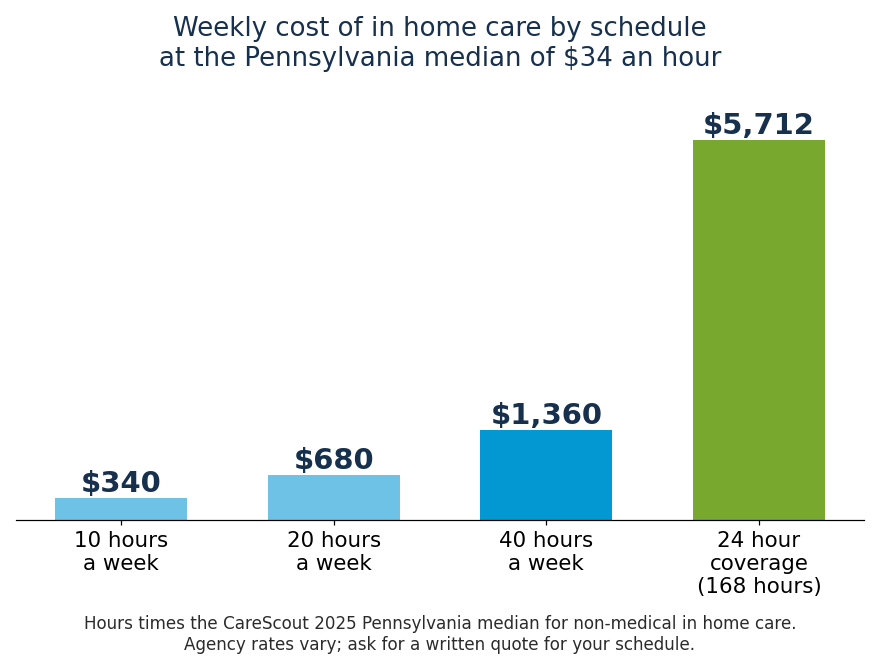
Ten hours a week comes to about $340, twenty hours to about $680, forty hours to about $1,360, and full 24 hour coverage (168 hours) to about $5,712 a week at the median rate. These are benchmarks, not quotes; agencies price around them, and the level of care changes the rate.
The useful comparison is not the hourly rate alone. It is the total weekly cost against the amount of safe coverage your parent actually needs. A parent who is safe overnight may only need daytime hours. A parent who is not safe overnight needs coverage that is awake, and that is where the shift model costs more but protects more. Ask any agency to price your parent’s real schedule in writing. For local numbers, see our pages on home care cost in Philadelphia and in home care cost in Bucks County.
Privacy, the Home Itself, and Family Involvement
Privacy matters as much as money. Live in care means a near constant presence in your parent’s home. Some people welcome the company. Others, especially those who have lived on their own for decades, find it hard to adjust. Hourly care leaves long stretches of the day when your parent has the house to themselves.
Think about the home as well. A live in caregiver needs a suitable place to sleep and rest. A small apartment or a home with no spare room makes that difficult, which pushes many families toward hourly or shift coverage.
Finally, think about your own role. Hourly care can fit around family who live nearby and cover the gaps. Round the clock care can relieve a family that is stretched thin, but you will still want to stay involved by checking in, reviewing the care plan, and watching how your parent is doing.
Paying for Care, Including Help for Veterans
Many families are surprised to learn what Medicare leaves out. Medicare’s own coverage page says it does not pay for “24-hour-a-day care at your home” or for “custodial or personal care that helps you with daily living activities (like bathing, dressing, or using the bathroom), when this is the only care you need” (Medicare.gov, Home health services). That is why families often pay privately, use long term care insurance, or look at Pennsylvania programs. Our explainer on Medicare versus Medicaid home care in Pennsylvania walks through the difference, and who qualifies for Medicaid home care in PA covers the Community HealthChoices waiver.
If your parent is a veteran or the surviving spouse of one, VA Aid and Attendance provides an added monthly payment for those who need help with daily activities (VA, Aid and Attendance benefits). A-Team is an enrolled VetAssist provider and handles the VA application at no cost; our veterans home care page explains how that works.
Families weighing other settings may also find our comparison of adult day services versus home care useful.
Why Families Bring This Decision to A-Team Home Care
A-Team Home Care has served families in Philadelphia, Bucks County, and the surrounding Pennsylvania counties since 2016, providing companion care, personal care, 24 hour care, and Medicare certified home health care. Our community recognition includes the Philadelphia Inquirer Philly Favorites, a Top 20 place on the Philadelphia100 in 2025, and Best of Bucks Senior Care on the 2025 Bucks Happening List. You can see the care we provide on our Philadelphia home care and Bucks County home care pages, and our explainer on what ACHC accreditation means is useful when you compare agencies.
When you call, we start with questions rather than a pitch: what a typical day looks like for your parent, where they struggle, how the nights go, and what your family can and cannot cover. Our guide to what to expect at a first care assessment explains that conversation.
How to Decide and When to Change the Plan
Work through a few plain questions. Is your parent safe alone at night? Could they get help quickly after a fall? Do they eat well and take medications correctly without prompting? Are they confused or distressed when alone? Honest answers usually point toward a level of care. For a structured walk through, use our aging parent care decision tree.
This is not a permanent choice. Signals that it is time to move from hourly visits to more coverage include:
- Falls, near falls, or new difficulty walking.
- Growing confusion, wandering, or restless nights.
- Missed medications or meals even with regular visits.
- A family caregiver who is exhausted or falling behind in their own life.
- Hours that keep being added until the schedule is nearly full.
If a parent recovers and grows stronger, it is just as reasonable to scale back. Review the arrangement every few months instead of setting it and forgetting it.
Frequently Asked Questions
Is live in care always better than hourly care?
No. Live in care puts a caregiver in the home day and night, but it only helps if your parent actually needs support around the clock. For a parent who is mostly independent, hourly care protects privacy and independence while covering the tasks that are hard. The right choice is the one that matches real needs.
Can we start with hourly care and switch later?
Yes, and many families do. Starting with a few visits a week lets your parent build trust with a caregiver and shows you where more help is needed. As needs grow, hours can be added, and a family that needs round the clock help can move to 24 hour care.
Does A-Team Home Care provide live in caregivers?
No. A-Team provides hourly care and 24 hour home care. For round the clock needs, caregivers work 8 or 12 hour shifts in rotation, so the person on duty is awake and alert through the night instead of sleeping in the home.
Does Medicare pay for hourly or live in home care?
Medicare states that it does not pay for 24 hour a day care at home, or for custodial or personal care such as bathing, dressing, or using the bathroom when that is the only care you need. Families often use private payment, long term care insurance, Pennsylvania Medicaid programs, or veterans benefits instead.
My father is a veteran. Is there financial help?
There may be. VA Aid and Attendance adds a monthly payment to a VA pension for eligible veterans and surviving spouses who need help with daily activities. A-Team is an enrolled VetAssist provider and handles the VA application at no cost, so mention veteran status on the first call.
If you are weighing hourly care against live in or 24 hour care for your parent, A-Team Home Care can talk it through with you. Call (215) 490-9994 or contact our team to describe your situation and get a written quote for your parent’s schedule.