

Hospital discharge often comes faster than families expect. A doctor signs off, a discharge planner hands over a folder of instructions, and suddenly you have hours, not days, to work out how your loved one will manage stairs, medications, meals, and the bathroom at home. If you are asking how soon a caregiver can start after a hospital discharge, the honest answer is that it depends on the kind of care, who is paying for it, and how early the agency hears from you. This guide explains each of those factors for families in Philadelphia, Bucks County, and the surrounding Pennsylvania counties, and what you can do to shorten the wait.
Why the First Weeks Home After Discharge Matter
The days after a hospital stay are a fragile stretch. Someone who was steady before surgery or illness may come home weak, dizzy, or confused by new medications. Federal rules treat this transition seriously. Hospitals must plan discharge “on a timely basis to ensure that appropriate arrangements for post-hospital care will be made before discharge,” and the process must include “the patient and his or her caregivers/support person(s) as active partners,” with a goal to “reduce the factors leading to preventable hospital readmissions” (42 CFR 482.43).
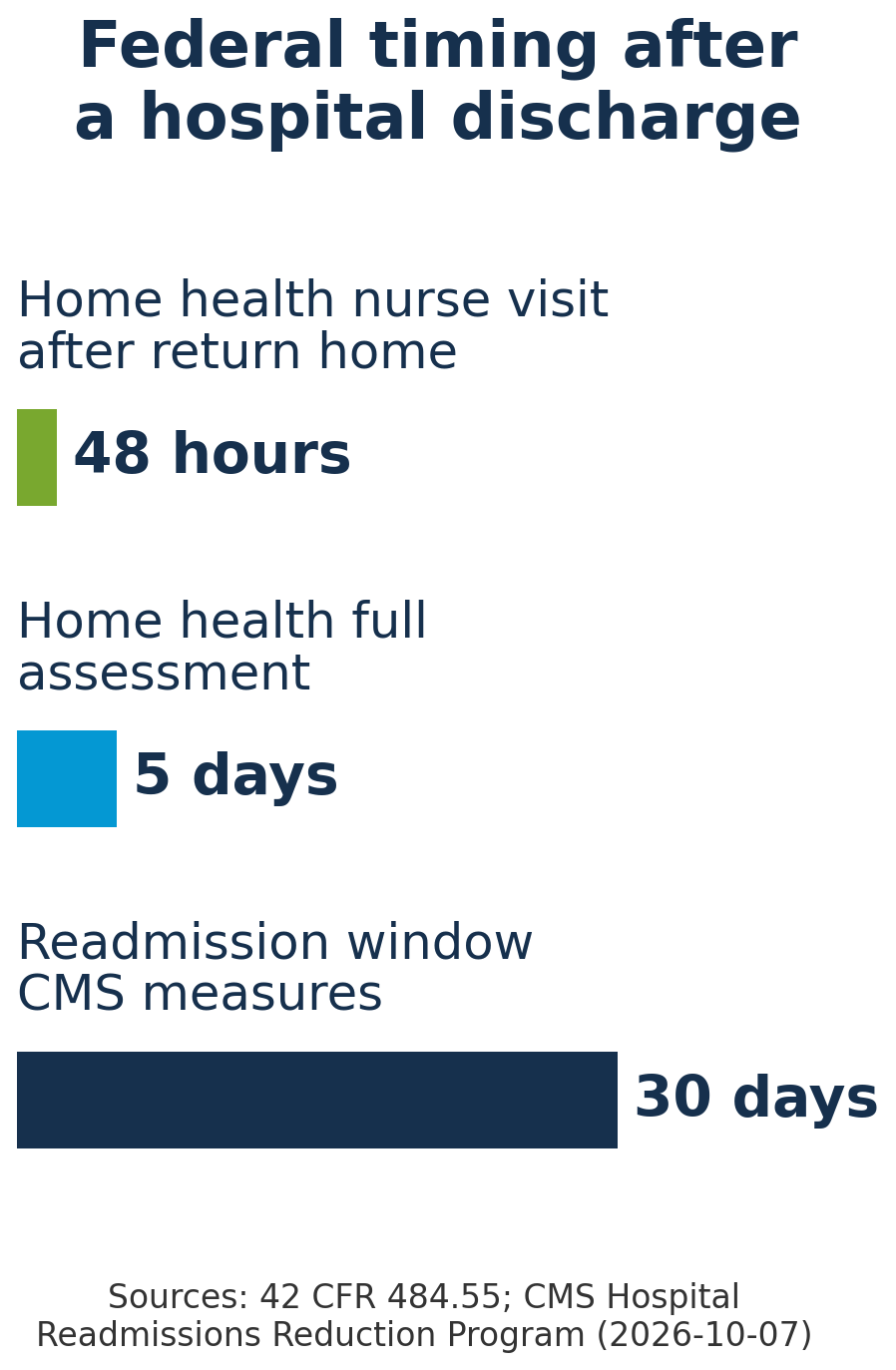
Medicare also tracks how often patients return. Its Hospital Readmissions Reduction Program measures unplanned readmissions within 30 days for conditions including heart failure, pneumonia, COPD, heart attack, bypass surgery, and elective hip and knee replacement (CMS, Hospital Readmissions Reduction Program). That 30 day window is a useful way for families to think about the first month home: it is when extra hands in the house count most.
How Soon Care Can Start Depends on the Type of Care
“Caregiver” covers two different services, and they start on different clocks.
Medicare home health (skilled care)
If your loved one’s doctor orders home health, such as nursing visits or physical therapy, federal rules set the timing. A registered nurse’s initial assessment visit must happen “within 48 hours of referral, or within 48 hours of the patient’s return home, or on the physician or allowed practitioner-ordered start of care date,” and the full assessment must be finished no later than 5 calendar days after the start of care (42 CFR 484.55). A-Team Home Care is Medicare certified for home health care, and our guide to what happens at a first care assessment walks through that nurse visit.
Non-medical home care (private pay)
Help with bathing, dressing, meals, medication reminders, and getting safely around the house is non-medical personal care. No federal clock applies. The start date depends on how quickly the agency can complete intake, review the discharge instructions, and match a caregiver whose experience fits the recovery. That is why the single biggest factor you control is when you make the first call.
Medicaid and VA funded care
If care will be paid through Pennsylvania’s Community HealthChoices program or through VA benefits, there are eligibility and approval steps before the program pays. Many families start with private pay or family help for the first days and move to program funding once it is approved. Our guide to getting home care covered through Community HealthChoices explains that process.
What Happens Before a Caregiver Walks Through the Door
A responsible agency does not send whoever happens to be free. A short intake process comes first:
- A conversation about the diagnosis or reason for the hospital stay, mobility, medications, and the daily routine
- A review of the written discharge instructions, including any weight bearing limits, wound care, or diet changes
- Agreement on hours, from a few hours a day to 24 hour home care
- Matching a caregiver with experience in similar recoveries, such as joint replacement, stroke, or weakness after a long illness
- A look at home safety: stairs, bathroom setup, rugs, and lighting
To make that first call faster, use our list of what to have ready before your first home care intake call.
What a Caregiver Does in the First Days Home
The first days after discharge are about stability. A non-medical caregiver in a post-hospital home typically helps with these activities of daily living:
- Reminders to take medications on schedule, exactly as the discharge instructions say
- Getting safely to and from the bathroom, bed, and chairs
- Preparing meals that follow any diet restrictions
- Light housekeeping so walkways stay clear
- Watching for warning signs, such as new confusion, worsening pain, fever, or redness at an incision, and telling the family or the medical team
- Company, which matters more than people expect during a recovery that can feel isolating
This is not medical care. It is the practical, hands-on help that keeps a recovery on track. Falls are a particular risk in the first weeks, so our room by room fall prevention guide is worth reading before discharge day.
Recoveries That Usually Need Fast Home Care Setup
Some discharges come with tighter timelines. Hip and knee replacement patients often go home soon after surgery but still need real help with mobility and bathing; both procedures are on the CMS readmission measure list above. Our hip replacement recovery timeline covers what to expect week by week. Other common situations include recovery from a fall, a heart event, pneumonia, and stroke, where mobility and speech may both be affected. In each case, having a rough plan before discharge day makes a real difference.
When a Family Member Wants to Be the Caregiver
Some families want a spouse, adult child, or other relative to provide care at first. That is a reasonable choice, and it does not have to be unpaid. Through our family caregiver program, an eligible family member may be paid for the care they already give (spouses and power of attorney holders cannot be the paid caregiver). Many families combine the two: a relative covers evenings, and an agency caregiver covers the hours the family cannot. Short respite care visits can also give a family caregiver a break during a long recovery.
Veterans and VA Aid and Attendance
For veterans and surviving spouses, VA Aid and Attendance is a monthly payment added to a VA pension for people who need help with daily activities such as bathing, feeding, and dressing (VA, Aid and Attendance benefits). It can help pay for home care, but the application takes time. If your loved one is a veteran, say so on the first call. Our VetAssist program page explains how we help families through it.
Local Experience During a Stressful Moment
A-Team Home Care has served families in Philadelphia, Bucks County, and the surrounding Pennsylvania counties since 2016, and hospital discharge is one of the most common reasons families first call us. Our caregivers already work in the neighborhoods where discharges happen. You can see the care we provide on our Philadelphia home care and Bucks County home care pages. Our community recognition includes the Philadelphia Inquirer Philly Favorites, a Top 20 place on the Philadelphia100 in 2025, and Best of Bucks Senior Care on the 2025 Bucks Happening List.
What You Can Do Before Discharge Day to Speed Things Up
- Call an agency as soon as you know a hospital stay or surgery is coming, even before you have every detail
- Ask the discharge planner or hospital social worker for the written discharge instructions as early as possible
- Ask whether the doctor is ordering home health, so you know if a nurse visit is coming and when
- Estimate how many hours of help you will need in the first two weeks
- Walk through the home for obvious hazards, such as loose rugs or stairs without a handrail
None of this needs to be perfect. The goal is to give the agency enough to move quickly once discharge is confirmed.
Frequently Asked Questions
How fast can a caregiver start after I call?
It depends on the type of care and how complete the information is. For Medicare home health, federal rules require the nurse’s first visit within 48 hours of referral or of the patient’s return home, or on the ordered start date. For private pay non-medical care, the start depends on intake and caregiver matching, so calling before discharge is the best way to shorten the wait.
Do I need to wait until discharge day to call an agency?
No. If a hospital stay or surgery is planned, calling ahead lets the agency finish intake and match a caregiver while your loved one is still in the hospital.
What information does the agency need before placing a caregiver?
Usually the reason for the hospital stay, current mobility, medications, the written discharge instructions, how many hours of care are needed, and any home safety concerns.
Can a family member be paid to provide the care?
Through a family caregiver program, an eligible family member may be paid for the care they already provide. There is an eligibility and application process.
Can VA benefits help pay for home care after a hospital stay?
VA Aid and Attendance is a monthly payment added to a VA pension for veterans and surviving spouses who need help with daily activities, and it can help pay for home care. Approval takes time, so mention veteran status on the first call.
If your loved one is about to come home from the hospital, or already has, and you need to know how quickly someone can be there, A-Team Home Care can talk it through with you. Call (215) 490-9994 or contact our team to start intake today.