

Melinda Piechoski, RN · Director of Nursing · Last updated May 5, 2026 · 9 min read
Medical disclaimer. This article provides general educational information based on published guidance from the American Academy of Orthopaedic Surgeons (AAOS), the National Institutes of Health, and Mayo Clinic. It is not medical advice. For care decisions specific to your loved one, call A-Team Home Care at (215) 490-9994 for a free RN assessment.
What hip replacement recovery actually involves
Total hip replacement is one of the most successful operations in modern medicine. The American Academy of Orthopaedic Surgeons (AAOS) reports that more than 450,000 total hip replacements are performed in the United States each year, with the vast majority of patients returning to most daily activities within three to six months. The National Institute of Arthritis and Musculoskeletal and Skin Diseases (NIAMS) describes the procedure as a reliable treatment for end-stage arthritis, and the Mayo Clinic notes that modern implants commonly last 15 to 20 years or longer.
The catch: surgical success does not equal home success. The 6 weeks after discharge are when complications happen — falls, dislocations, blood clots, infections, and uncontrolled pain. The single biggest factor that determines a smooth recovery is whether the home is properly prepared and staffed before your parent walks through the door.
Before surgery: the home preparation checklist
Most surgeons hold a pre-operative class that covers home preparation. If your parent is going to be discharged home (most are, the same day or after one night), do the following before the surgery date:
- Move the bedroom to the first floor if possible, or arrange a recliner or hospital bed in the living room for the first 1–2 weeks.
- Install grab bars in the shower and next to the toilet. Our companion guide, Elder-Proofing the Bathroom: 23 Changes to Prevent Falls, walks through every fix in detail.
- Add a raised toilet seat with armrests — standard toilets are too low and force forbidden hip flexion.
- Buy a shower bench and a long-handled shower brush.
- Remove all throw rugs from walking paths.
- Pre-cook and freeze meals for the first two weeks.
- Set up a recovery zone: recliner, side table within reach, water, phone, charger, remote, books, tissues, walker.
- Stock the bathroom: stool softener (constipation from anesthesia and opioids is universal), the prescribed anticoagulant for blood clot prevention, ice packs, and any pain medications.
- Confirm home health agency, durable medical equipment delivery, and any home care aide schedule before surgery day.
Hip precautions: the rules that prevent dislocation
Depending on the surgical approach (anterior, posterior, or lateral), your parent’s surgeon will give specific precautions. The AAOS standard posterior-approach precautions are: do not bend the operated hip beyond 90 degrees, do not cross the legs at the knee or ankle, and do not turn the operated leg inward. These rules typically apply for the first 6 weeks.
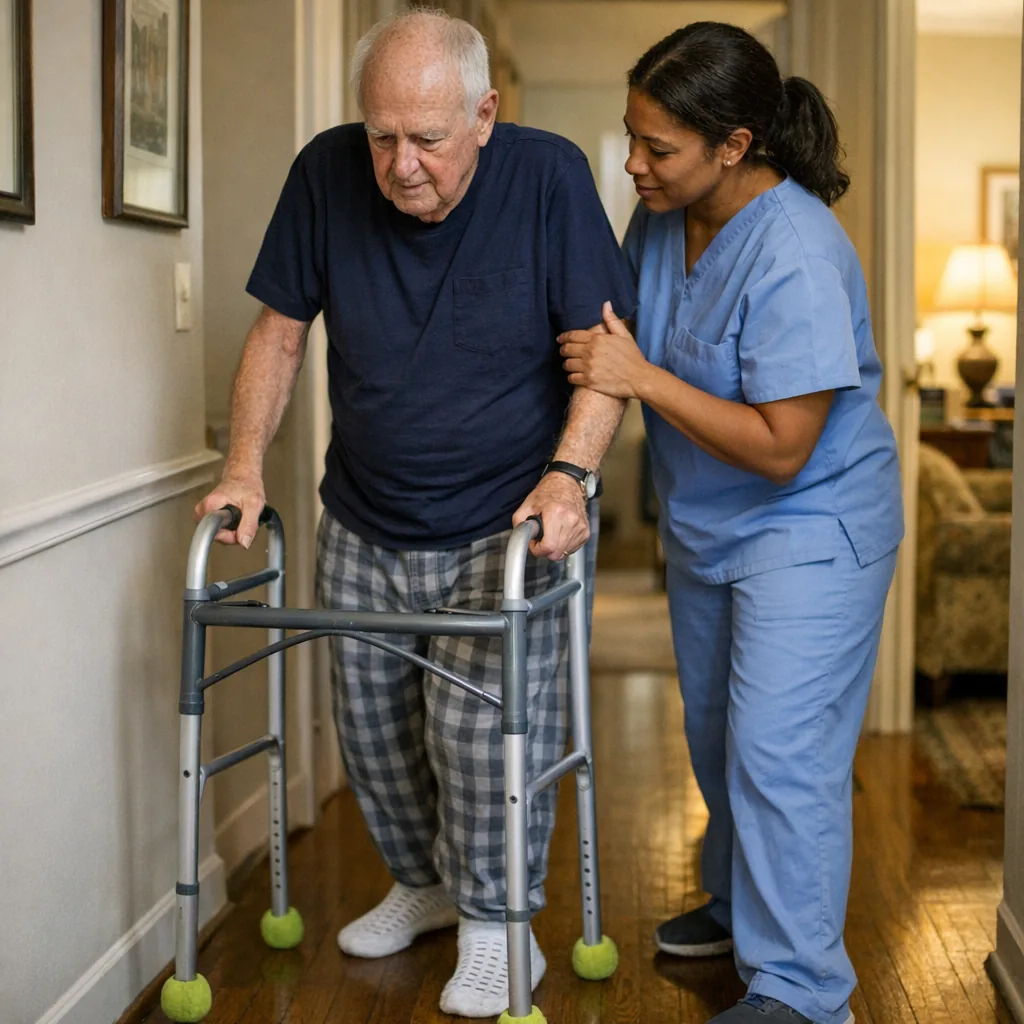
Practical translation for the home: no low chairs, no leaning forward to put on socks or pick something up, no crossing the operated leg, no twisting on the operated leg. Tools that help your parent obey precautions include a long-handled reacher, sock aid, long-handled shoehorn, and elastic shoelaces. If a caregiver is helping with bathing or dressing, those same precautions apply hands-on — this is one of the most common reasons families add personal care support during weeks 1–6.
Week-by-week recovery timeline
Week 1: home from hospital, walker is mandatory
The first week is about pain control, blood clot prevention, and basic mobility. Per Mayo Clinic post-operative guidance, expect frequent walks around the room with a walker, sleeping in a recliner or with pillows positioned to protect the hip, and ice every 2–3 hours for swelling. A home health physical therapist usually visits 2–3 times this week. Pain medication is taken on a schedule, not on demand.
Weeks 2–3: more activity, fewer narcotics
Most patients transition off opioids and onto acetaminophen and as-needed anti-inflammatories during these weeks. Walking distance increases. Stair practice begins with the home PT. Bathing in the shower (sitting on the bench) replaces sponge baths around the time the incision is healed and the surgeon clears it. This is also when families typically realize that two or three weekly home health visits are not enough — a daily aide for bathing, dressing, and meal prep makes the difference between progress and a setback.
Weeks 4–6: walker to cane
Most patients transition from walker to cane (held in the hand opposite the operated leg) around week 4–6 if the surgeon clears it. Outpatient physical therapy often starts here if not earlier. Driving may resume around week 6 for a left hip replacement and later for a right hip replacement, only after the surgeon clears it.
Weeks 7–12: return to normal life, slowly
Pain at this stage should be minimal. The hip continues to gain strength and range of motion. Hip precautions may be relaxed at the surgeon’s 6-week visit, but full recovery and return to higher-impact activity often takes 3–6 months. AAOS guidance identifies running, contact sports, and high-impact exercise as activities to avoid permanently — the goal is preserving the implant for 20+ years.
Warning signs — when to call the surgeon or 911
Call the surgeon’s office the same day for: redness, drainage, or warmth at the incision site; fever above 101°F; calf pain or swelling on either leg; sudden new hip pain; any sense that the hip popped or shifted; or pain that is not controlled by the prescribed medication.
Call 911 immediately for: chest pain or shortness of breath (possible pulmonary embolism), confusion or sudden weakness, sudden severe hip pain with the leg appearing shorter or rotated (possible dislocation), or fainting. Pulmonary embolism is the most feared post-surgical complication and is the reason your parent is on a blood thinner.
How A-Team Home Care fills the post-surgical gap
Most insurance plans authorize a few visits per week of home health physical therapy and skilled nursing — not the daily hands-on help an older adult actually needs after hip replacement. The bath, the meal, the walker assistance to the bathroom in the middle of the night, the medication reminder, the watchful eye that prevents a fall — that is home care, and it is what A-Team provides. Our most-used services for post-surgical recovery include personal care for daily bathing, dressing, and meal prep, companion care for the watchful presence that prevents falls during the highest-risk first weeks, 24-hour home care for the first one to two weeks home when fall risk is highest, and skilled nursing for medication management and incision monitoring. A-Team Home Care has been ACHC-accredited since 2018 and serves Philadelphia, Bucks, Montgomery, Delaware, and Chester counties. Call (215) 490-9994 for a free in-home RN assessment, ideally before the surgery date.
Frequently asked questions
How long will my parent stay in the hospital after a hip replacement?
Most hip replacements in 2026 are same-day or one-night stays. Some older adults with multiple medical conditions stay 2–3 nights. Patients who cannot safely go home (due to home environment, fall risk, or insufficient support) may be discharged to a skilled nursing facility for short-term rehabilitation. The discharge decision is made by the surgical team based on safety, not on a fixed length of stay.
Will Medicare pay for home care after hip replacement?
Medicare covers skilled home health services after hip replacement when ordered by the surgeon: physical therapy, occupational therapy, and intermittent skilled nursing for a defined episode. Daily personal care, bathing assistance, meal preparation, and supervision are not covered by Medicare and are paid privately, through long-term care insurance, or through Pennsylvania’s Community HealthChoices Medicaid waiver. Most families pay out of pocket for the first 2–6 weeks of personal care.
How long do I need to use a walker after hip replacement?
Most patients use a walker for the first 2–6 weeks after surgery, then transition to a cane in the hand opposite the operated leg for another few weeks. The exact timeline depends on the surgical approach, the patient’s strength and balance, and the surgeon’s clearance. Do not transition off the walker without your physical therapist or surgeon’s approval.
What are the most common complications of hip replacement?
The most serious complications are blood clots (deep vein thrombosis and pulmonary embolism), infection of the joint, dislocation, and falls. Modern protocols including blood thinners, early walking, and adherence to hip precautions have dramatically lowered complication rates. Most patients have an uneventful recovery if home support is adequate. Always follow the discharge instructions from the surgical team.
When can my parent return to driving after hip replacement?
Driving typically resumes around 4–6 weeks for a left hip replacement and 6–8 weeks for a right hip replacement, but only after the surgeon clears it. Reaction time, ability to brake quickly, and freedom from narcotic pain medication all matter. Do not let your parent drive while taking opioid pain medication.
What if my parent had hip fracture surgery, not elective hip replacement?
Hip fracture surgery (after a fall) has a different and more difficult recovery than elective hip replacement. Patients are often older, more medically complex, and have less reserve. Many require a stay in a skilled nursing facility for several weeks before returning home. The home setup and home care needs are similar, but the timeline is longer and the fall-prevention work is more urgent.
Can family members be paid to care for a parent recovering from hip surgery?
Yes, in many cases. Pennsylvania’s Community HealthChoices Medicaid waiver allows qualifying family members to be paid as personal care attendants for a Medicaid-eligible parent. The three CHC managed care plans are Keystone First Community HealthChoices, UPMC Community HealthChoices, and PA Health & Wellness. A-Team Home Care’s Family Caregiver Program walks Pennsylvania families through enrollment, and our step-by-step guide, Becoming a Paid Family Caregiver in Pennsylvania: 7 Steps to Your First Paycheck, explains the process. Pay is bi-weekly — A-Team caregivers are paid every other Friday on a 14-day cycle. If your parent is a Pennsylvania veteran, our guide to PA Veterans Benefits Beyond VetAssist covers additional funding paths for in-home care.
Before you go: the bathroom is where falls happen
The single highest-risk room during hip recovery is the bathroom — wet floors, low toilets, and tight turns are exactly the conditions that cause dislocations and re-hospitalizations. Before discharge day, walk through every bathroom your parent will use with our free Bathroom Fall Prevention Checklist. It covers the 23 specific changes that turn a hostile bathroom into a recovery-safe one. Print it, hand it to whoever is doing the home prep, and check it off room by room.
Sources & further reading
- American Academy of Orthopaedic Surgeons (OrthoInfo) — Total Hip Replacement
- American Academy of Orthopaedic Surgeons (OrthoInfo) — Activities After Hip Replacement
- Mayo Clinic — Hip replacement surgery: Overview & Recovery
- National Institute of Arthritis and Musculoskeletal and Skin Diseases — Hip Replacement Surgery
- Centers for Medicare & Medicaid Services — Home Health Services Coverage
- National Institute on Aging — Preventing Falls at Home
- Centers for Disease Control and Prevention — Older Adult Fall Prevention
- Pennsylvania Department of Human Services — Community HealthChoices
Disclaimer
This article is for educational purposes only and does not constitute medical advice. Post-surgical recovery decisions should always be made in consultation with your parent’s orthopedic surgeon, primary care physician, and rehabilitation team. A-Team Home Care is an ACHC-accredited home care agency serving Pennsylvania.
Follow A-Team on Instagram
Real moments from real shifts — caregivers, clients, milestones, team events. @ateamhomecare · updated weekly.