

If you spend your days helping your husband or wife dress, eat, move safely, and take medicine, you are already doing the work of a caregiver. It is natural to ask whether anyone will pay you for it. The honest answer in Pennsylvania is: sometimes, but not through the route most families expect. The rules depend on who is paying for care, and spouses are treated differently from other relatives under several programs.
This guide explains how the main funding sources treat a spouse, what options exist for veteran couples, and what to do if you need help and still want to remain your partner’s husband or wife first. A-Team Home Care serves families in Philadelphia, Bucks County, and the surrounding Pennsylvania counties, and we talk with couples in this situation often.
The Short Answer for Pennsylvania Couples
There is no single Pennsylvania rule that says “a spouse can” or “a spouse cannot” be paid. Pay for family caregiving is tied to a specific program, and each program sets its own rules. In general:
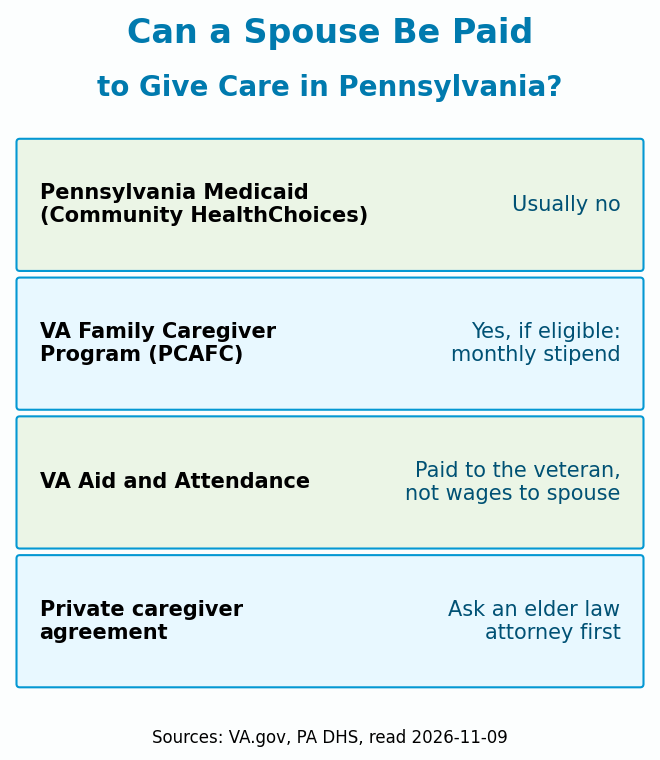
- Medicaid-funded home care: Programs that let a person direct their own care often allow a relative to be hired, but a spouse is commonly treated as a legally responsible person and is usually excluded from being paid.
- VA programs: Some veteran programs can support a family caregiver, including a spouse, but eligibility is narrow and tied to the veteran’s service and condition.
- Private arrangements: Couples can sometimes use savings, long-term care insurance, or other resources, depending on the policy terms and the paperwork.
Because programs and policies change, treat any article, including this one, as a starting point. Confirm the current rule with the program that would pay before you quit a job or change your household plans.
How Medicaid and Community HealthChoices Treat Spouses
Many Pennsylvanians who need long-term help at home receive it through Medicaid. For older adults and adults with physical disabilities, that usually means Community HealthChoices, often shortened to CHC. Participants in CHC are assigned a managed care organization and a service coordinator who builds a care plan.
Some participants can choose to direct their own services and hire their own workers. That option is the reason so many families search for ways to be paid. Adult children, grandchildren, and other relatives may be hired in some cases. A spouse is a different matter. Medicaid programs generally consider a spouse to have a duty to support their partner, so paying a spouse for ordinary care is commonly not allowed. The details vary by waiver and by year, so the service coordinator is the right person to ask.
If your loved one is on CHC or thinking about applying, our Community HealthChoices family caregiver pay guide walks through how the program works for relatives. You can read general program information from the federal Medicaid home and community-based services overview and from the Pennsylvania Department of Human Services.
Even when a spouse cannot be the paid worker, Medicaid can often still pay for a different caregiver to come into the home. That frees the spouse to rest, keep appointments, and stay in the role of partner rather than full-time aide.
Options for Veteran Couples
Veterans and their spouses have more possibilities than most families realize. A-Team Home Care is a Philadelphia home care agency that helps veterans get their VA Aid and Attendance benefits, so this is a part of the conversation we know well.
Aid and Attendance. This is an increased monthly pension amount available to some wartime veterans and surviving spouses who need help with daily activities and meet VA financial and service requirements. The payment goes to the veteran or surviving spouse, and families commonly use it to help cover the cost of care at home. It is not a salary for a spouse. It is added income that can help pay for caregivers. Read the current requirements on the VA Aid and Attendance and Housebound page.
VA caregiver support. The VA Program of Comprehensive Assistance for Family Caregivers is one of the few programs that can pay a spouse. VA.gov lists a spouse among the family members who can qualify, the caregiver must be at least 18, and an approved primary family caregiver can receive a monthly stipend. The veteran usually needs a service connected disability rating of 70% or higher and in person help with personal care for at least six continuous months (VA.gov, Program of Comprehensive Assistance for Family Caregivers). Start at the VA Caregiver Support Program site or call the Caregiver Support Line at 1-855-260-3274 to see whether your situation fits.
These programs have specific forms and evidence requirements. Many families find that a little guidance early saves months of frustration. If your spouse served, tell us when you call. We can talk through how Aid and Attendance fits alongside professional home care.
Other Ways Couples Cover the Cost of Care
When a spouse cannot be paid through a public program, couples often look at several other resources together.
- Long-term care insurance. Some policies pay for home care, and the policy language decides who may be paid. Some require a licensed agency, and some limit payment to family members. Read the policy or call the insurer and ask directly.
- Personal savings and income. Many families pay privately for a set number of hours each week and add more over time as needs grow.
- Veteran benefits. As described above, Aid and Attendance can add monthly income for eligible veterans and surviving spouses.
- Medicaid. If your partner qualifies, Medicaid may cover care delivered by someone other than you.
Be careful with informal arrangements. If a couple signs a “caregiver agreement” in which one spouse pays the other, it can affect Medicaid eligibility, tax filings, and benefit calculations. A qualified elder law attorney or tax professional can tell you what applies to your situation. The IRS explains household employer basics in Publication 926, including how wages paid to a spouse are treated.
If your question is really about getting paid to care for any family member, not only a spouse, these pages cover the broader picture: getting paid to care for a family member in Pennsylvania, how to get paid to care for a family member, and the step-by-step guide to a paid family caregiver’s first paycheck.
Why Many Spouses Choose an Agency Caregiver Instead
Even where a spouse could be paid, many couples decide that the healthiest plan is to bring in outside help. Caring for a husband or wife is different from caring for a parent or neighbor. You are grieving changes in the person you love while performing tasks that are physically and emotionally heavy. Caregiver exhaustion is common among spouses, and it can put your own health at risk.
An agency caregiver can handle the parts of the day that are hardest to do alone, such as bathing, transfers, and meal preparation, while you stay in the role of partner. With an agency, scheduling, backup coverage, and screening are handled by the office, not by you. If you are weighing a private hire against an agency, our comparison of agency caregivers versus private hire lays out the tradeoffs in plain terms.
Here are signs that it may be time to add help:
- You are not sleeping well because you are listening for your spouse at night.
- Lifting, transfers, or bathing have become physically risky for you or for them.
- You are skipping your own medical appointments.
- Your partner has had a fall, a hospital stay, or a recent surgery. Our guide to the recovery timeline after hip replacement shows how much extra help the first weeks can require.
- You feel more like a nurse than a husband or wife.
Our services include companion care and personal care, with caregivers who help your loved one stay safe and comfortable at home. Companion care covers company, meals, and light household help. Personal care adds hands-on support with daily activities such as bathing, dressing, and moving around the home. For families who need more coverage, A-Team can arrange up to 24 hours per day of care, including 24-Hour care with rotating caregiver shifts.
Our Experience Helping Pennsylvania Families
A-Team Home Care is a home care agency that has served Philadelphia, Bucks County, and the surrounding Pennsylvania counties for years. In that time we have worked with families at every stage: a spouse who needs a few hours a week so they can run errands, adult children coordinating care from out of town, and couples facing a sudden change after a hospital stay. Questions about who can be paid, and by whom, come up again and again, and we have learned to answer them plainly.
Our work has been recognized locally, including the Philadelphia Inquirer’s Philly’s Favorite (2025), the Philadelphia100, and the Bucks Happening List. We are proud of that, but what matters more to the families we serve is practical: caregivers who show up, treat your loved one with respect, and make the home safer and calmer. We also help veterans pursue their VA Aid and Attendance benefits, which is a distinction we take seriously.
We are an agency, not a government office or law firm, so we do not decide benefit eligibility or give legal or tax advice. What we can do is explain what we see families go through, point you to the right official sources, and provide the caregiver support that lets a spouse breathe.
What to Do This Week If You Are a Spouse Caregiver
You do not have to solve everything at once. These steps give you a clear starting point.
- Write down the daily tasks. List what you do for your spouse in a normal day and which tasks are hardest. This helps any program or agency understand the level of care required.
- Find out who the payer is. Is your spouse on Medicaid or CHC, covered by a long-term care policy, or a veteran? Each path has its own rules and its own contact.
- Ask about spouse rules directly. Call the service coordinator, insurer, or VA representative and ask, “Can a spouse be paid under this program?” Get the answer in writing when possible.
- Check veteran benefits. If your husband or wife served, ask about Aid and Attendance and the VA caregiver program before assuming you have no options.
- Protect your own health. Schedule your appointments and arrange regular breaks, even short ones.
- Talk to an agency. A conversation about care hours does not commit you to anything, and it shows you what help would look like at home.
If you are a caregiver looking for work rather than a family member looking for help, we also welcome people who want to join our team and care for clients as a profession. You can reach out through Become a Caregiver on our site. We are also proud of the people who do this work, which you can see in our caregiver appreciation party.
Talk to A-Team Home Care about your situation.
Frequently Asked Questions
Can my husband or wife be paid by Pennsylvania Medicaid to care for me?
Usually not. Medicaid programs generally treat a spouse as a legally responsible person, and that often means a spouse cannot be paid as the direct care worker, even when other relatives can. Rules vary by program and can change, so ask your Community HealthChoices service coordinator for the current answer. Medicaid may still pay for another caregiver to help in the home.
Can a veteran’s spouse be paid for caregiving?
It depends on the program. The VA has a caregiver support program for family members of eligible veterans, and it can include a stipend, but eligibility is specific. Aid and Attendance is a pension amount paid to the veteran or surviving spouse, not wages for the spouse. A-Team helps veterans pursue Aid and Attendance, and we can explain how it fits with professional home care.
Can I be paid if I have a caregiver agreement with my spouse?
A private agreement between spouses can create problems for Medicaid eligibility, taxes, and other benefits, and it may not be recognized by programs that exclude spouses. Talk with an elder law attorney or tax professional before signing anything. They can tell you how it applies to your finances.
If I cannot be paid, can I still get help caring for my spouse?
Yes. Many couples bring in an agency caregiver for a set number of hours each week so the spouse can rest and stay in the role of partner. A-Team Home Care provides companion care and personal care in Philadelphia, Bucks County, and surrounding counties, and can arrange up to 24 hours per day of care when needed.
Which Pennsylvania counties does A-Team Home Care serve?
We serve Philadelphia, Bucks County, and the surrounding Pennsylvania counties. If you are not sure whether your address is covered, call or send a message and we will tell you.
Talk With A-Team Home Care
If you are caring for a spouse and wondering what help is available, we would be glad to talk. Contact A-Team Home Care to start patient services, ask about Aid and Attendance for a veteran in your family, or learn what a few hours of professional help each week could look like. If you want to work as a caregiver yourself, choose Become a Caregiver and our team will be in touch.